Advertisements
Advertisements
Question
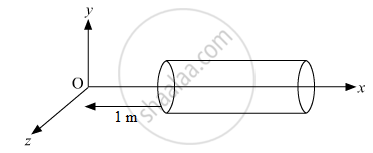
A hollow cylindrical box of length 1 m and area of cross-section 25 cm2 is placed in a three dimensional coordinate system as shown in the figure. The electric field in the region is given by `vecE = 50xhati` where E is NC−1 and x is in metres. Find
(i) Net flux through the cylinder.
(ii) Charge enclosed by the cylinder.
Advertisements
Solution
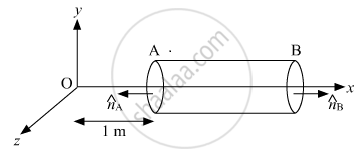
Given,`vecE = 50xhati and Δs = 25 cm^2 = 25 xx 10^-4 m^2`
As the electric field is only along the x-axis, so, flux will pass only through the cross-section of cylinder.
magnitude of electric field at cross - section A,`E_A = 50 xx 1 =50N C^-1`
magnitude of electric field at cross - section `B,E^B = 50 xx 2 = 100 N C^-1`
The corresponding electric fluxes are :
`ø_A = vecE.Δvecs = 50 xx 25 xx 10^-4 xx cos 180° = -0.125 N m^2 C^-1`
`ø_A = vecE.Δvecs = 100 xx 25 xx 10^-4 xx cos 0° = 0.25N m^2 C^-1`
So, the net flux through the cylinder,`ø =ø_A +ø_B = -0.125 + 0.25 = 0 . 125 N m^2C^-1 `
(ii) Using Gauss’s law: `ointvecE.dvecs =q/in_0⇒ 0.125 = q/(8.85 xx 10^-12)⇒ q=8.85 xx 0.125 xx 10^-12 =1.1 xx 10 ^-12 C `
RELATED QUESTIONS
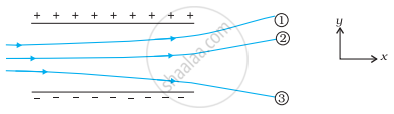
The figure shows tracks of three charged particles in a uniform electrostatic field. Give the signs of the three charges. Which particle has the highest charge to mass ratio?
Can a gravitational field be added vectorially to an electric field to get a total field?
The electric field and the electric potential at a point are E and V, respectively.
Electric potential decreases uniformly from 120 V to 80 V, as one moves on the x-axis from x = −1 cm to x = +1 cm. The electric field at the origin
(a) must be equal to 20 Vcm−1
(b) may be equal to 20 Vcm−1
(c) may be greater than 20 Vcm−1
(d) may be less than 20 Vcm−1
A 10-cm long rod carries a charge of +50 μC distributed uniformly along its length. Find the magnitude of the electric field at a point 10 cm from both ends of the rod.
A particle of mass 1 g and charge 2.5 × 10⁻⁴ C is released from rest in an electric field of 1.2 × 10 4 N C−1. Find the electric force and the force of gravity acting on this particle. Can one of these forces be neglected in comparison with the other for approximate analysis?
A particle of mass 1 g and charge 2.5 × 10⁻⁴ C is released from rest in an electric field of 1.2 × 10 4 N C−1. How long will it take for the particle to travel a distance of 40 cm?
A particle of mass 1 g and charge 2.5 × 10⁻⁴ C is released from rest in an electric field of 1.2 × 10 4 N C−1. What will be the speed of the particle after travelling this distance?
A ball of mass 100 g and with a charge of 4.9 × 10⁻⁵ C is released from rest in a region where a horizontal electric field of 2.0 × 10⁴ N C−1 exists. (a) Find the resultant force acting on the ball. (b) What will be the path of the ball? (c) Where will the ball be at the end of 2 s?
Two similar spheres having +Q and -Q charges are kept at a certain distance. F force acts between the two. If at the middle of two spheres, another similar sphere having +Q charge is kept, then it experiences a force in magnitude and direction as ______.
