Advertisements
Advertisements
प्रश्न
A capacitor of unknown capacitance is connected across a battery of V volts. The charge stored in it is 360 μC. When potential across the capacitor is reduced by 120 V, the charge stored in it becomes 120 μC.
Calculate:
(i) The potential V and the unknown capacitance C.
(ii) What will be the charge stored in the capacitor, if the voltage applied had increased by 120 V?
Advertisements
उत्तर
(i) Initial voltage, V1 = V volts and charge stored, Q1 = 360 µC.
Q1 = CV1 …(1)
Changed potential, V2 = V − 120
Q2 = 120 µC
Q2 = CV2 ...(2)
By dividing (2) from (1), we get `Q_1/Q_2 = (CV_1)/(CV_1) ⇒360/120 = V/(V-120)⇒ V= 180` volts
`∴C = Q_1/V_1 =( 360 xx10^-6)/180 = 2 xx 10^-6 F = 2μF`
(ii) If the voltage applied had increased by 120 V, then V3 = 180 + 120 = 300 V
Hence, charge stored in the capacitor, Q3 = CV3 = 2×10-6×300 = 600 µC
संबंधित प्रश्न
A capacitor of capacitance ‘C’ is being charged by connecting it across a dc source along with an ammeter. Will the ammeter show a momentary deflection during the process of charging? If so, how would you explain this momentary deflection and the resulting continuity of current in the circuit? Write the expression for the current inside the capacitor.
As `C = (1/V) Q` , can you say that the capacitance C is proportional to the charge Q?
Two metal spheres of capacitance C1 and C2 carry some charges. They are put in contact and then separated. The final charges Q1 and Q2 on them will satisfy
Three capacitors having capacitances 20 µF, 30 µF and 40 µF are connected in series with a 12 V battery. Find the charge on each of the capacitors. How much work has been done by the battery in charging the capacitors?
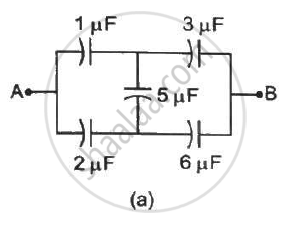
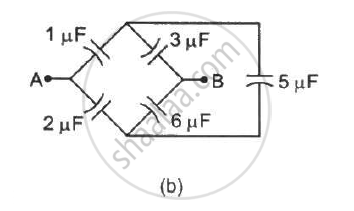
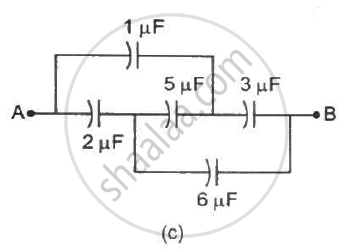
Convince yourself that parts (a), (b) and (c) figure are identical. Find the capacitance between the points A and B of the assembly.
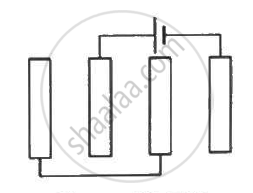
Each of the plates shown in figure has surface area `(96/∈_0) xx 10^-12` Fm on one side and the separation between the consecutive plates is 4⋅0 mm. The emf of the battery connected is 10 volts. Find the magnitude of the charge supplied by the battery to each of the plates connected to it.
A parallel-plate capacitor has plate area 100 cm2 and plate separation 1⋅0 cm. A glass plate (dielectric constant 6⋅0) of thickness 6⋅0 mm and an ebonite plate (dielectric constant 4⋅0) are inserted one over the other to fill the space between the plates of the capacitor. Find the new capacitance.
A parallel-plate capacitor with the plate area 100 cm2 and the separation between the plates 1⋅0 cm is connected across a battery of emf 24 volts. Find the force of attraction between the plates.
The plates of a parallel plate capacitor are separated by d. Two slabs of different dielectric constant K1 and K2 with thickness `3/8 d and d/2`, respectively, are inserted in the capacitor. Due to this, the capacitance becomes two times larger than when there is nothing between the plates. If K1 = 1.25 K, the value of K1 is:
