हिंदी

A Small Conducting Sphere of Radius 'R' Carrying a Charge +Q Is Surrounded by a Large Concentric Conducting Shell of Radius Ron Which a Charge +Q Is Placed. - Physics

Advertisements
Advertisements

प्रश्न

A small conducting sphere of radius 'r' carrying a charge +q is surrounded by a large concentric conducting shell of radius Ron which a charge +Q is placed. Using Gauss's law, derive the expressions for the electric field at a point 'x'
(i) between the sphere and the shell (r < x < R),
(ii) outside the spherical shell.

Advertisements

उत्तर १

Consider a sphere of radius r with centre O surrounded by a large concentric conducting shell of radius R.

To calculate the electric field intensity at any point P, where OP = x, imagine a Gaussian surface with centre O and radius x, as shown in the figure given above.

The total electric flux through the Gaussian surface is given by

`ø = oint_s Eds = E oint_s \ ds`

Now,

`oint \ ds = 4πx^2`

`∴ø = E xx 4πx^2   ....... (1) `

Since the charge enclosed by the Gaussian surface is q, according to Gauss's theorem,

`ø = q/ε_0    ....... (2)`

From (i) and (ii), we get

` E xx 4πx^2 = q/ε_0 `

⇒`E = q/(4πε_0x^2 )`

shaalaa.com

उत्तर २

(1) Consider a sphere of radius r with centre O surrounded by a large concentric conducting shell of radius R.

To calculate the electric field intensity at any point P, where OP = x, imagine a Gaussian surface with centre O and radius x, as shown in the figure given above.

The total electric flux through the Gaussian surface is given by

`ø = oint_s Eds = E oint_s \ ds`

Now,

`oint \ ds = 4πx^2`

`∴ø = E xx 4πx^2   ....... (1) `

Since the charge enclosed by the Gaussian surface is q, according to Gauss's theorem,

`ø = q/ε_0    ....... (2)`

From (i) and (ii), we get

` E xx 4πx^2 = q/ε_0 `

⇒`E = q/(4πε_0x^2 )`

(2)
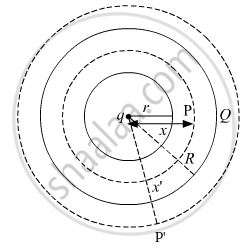
To calculate the electric field intensity at any point P', where point P' lies outside of the spherical shell, imagine a Gaussian surface with centre O and radius x', as shown in the figure given above.
According to Gauss's theorem,

` E' xx 4πx^'2 = (q+Q)/ε_0 `

⇒`E = (q+Q)/(4πx'^ 2 )`

As the charge always resides only on the outer surface of a conduction shell, the charge flows essentially from the sphere to the shell when they are connected by a wire. It does not depend on the magnitude and sign of charge Q.

shaalaa.com
  क्या इस प्रश्न या उत्तर में कोई त्रुटि है?
2014-2015 (March) Foreign Set 2

वीडियो ट्यूटोरियलVIEW ALL [1]

संबंधित प्रश्न

 Use Gauss's law to find the electric field due to a uniformly charged infinite plane sheet. What is the direction of field for positive and negative charge densities?


Find the ratio of the potential differences that must be applied across the parallel and series combination of two capacitors C1 and C2 with their capacitances in the ratio 1 : 2 so that the energy stored in the two cases becomes the same.


An infinitely large thin plane sheet has a uniform surface charge density +σ. Obtain the expression for the amount of work done in bringing a point charge q from infinity to a point, distant r, in front of the charged plane sheet. 


A point object is placed on the principal axis of a convex spherical surface of radius of curvature R, which separates the two media of refractive indices n1 and n2 (n2 > n1). Draw the ray diagram and deduce the relation between the object distance (u), image distance (v) and the radius of curvature (R) for refraction to take place at the convex spherical surface from rarer to denser medium.


Using Gauss’ law deduce the expression for the electric field due to a uniformly charged spherical conducting shell of radius R at a point

(i) outside and (ii) inside the shell.

Plot a graph showing variation of electric field as a function of r > R and r < R.

(r being the distance from the centre of the shell)


How is the field directed if (i) the sheet is positively charged, (ii) negatively charged?


A charge Q is uniformly distributed on a spherical shell. What is the field at the centre of the shell? If a point charge is brought close to the shell, will the field at the centre change? Does your answer depend on whether the shell is conducting or non-conducting?


A rubber balloon is given a charge Q distributed uniformly over its surface. Is the field inside the balloon zero everywhere if the balloon does not have a spherical surface?


A spherical volume contains a uniformly distributed charge of density  2.0 × 10 -4 Cm-3 Find the electric field at a point inside the volume at a distance 4⋅0 cm from the centre.


If one penetrates a uniformly charged spherical cloud, electric field strength ______.

Share
Notifications

Englishहिंदीमराठी


      Forgot password?
Use app×