Advertisements
Advertisements
प्रश्न
A small conducting sphere of radius 'r' carrying a charge +q is surrounded by a large concentric conducting shell of radius Ron which a charge +Q is placed. Using Gauss's law, derive the expressions for the electric field at a point 'x'
(i) between the sphere and the shell (r < x < R),
(ii) outside the spherical shell.
Advertisements
उत्तर १
Consider a sphere of radius r with centre O surrounded by a large concentric conducting shell of radius R.

To calculate the electric field intensity at any point P, where OP = x, imagine a Gaussian surface with centre O and radius x, as shown in the figure given above.
The total electric flux through the Gaussian surface is given by
`ø = oint_s Eds = E oint_s \ ds`
Now,
`oint \ ds = 4πx^2`
`∴ø = E xx 4πx^2 ....... (1) `
Since the charge enclosed by the Gaussian surface is q, according to Gauss's theorem,
`ø = q/ε_0 ....... (2)`
From (i) and (ii), we get
` E xx 4πx^2 = q/ε_0 `
⇒`E = q/(4πε_0x^2 )`
उत्तर २
(1) Consider a sphere of radius r with centre O surrounded by a large concentric conducting shell of radius R.
To calculate the electric field intensity at any point P, where OP = x, imagine a Gaussian surface with centre O and radius x, as shown in the figure given above.
The total electric flux through the Gaussian surface is given by
`ø = oint_s Eds = E oint_s \ ds`
Now,
`oint \ ds = 4πx^2`
`∴ø = E xx 4πx^2 ....... (1) `
Since the charge enclosed by the Gaussian surface is q, according to Gauss's theorem,
`ø = q/ε_0 ....... (2)`
From (i) and (ii), we get
` E xx 4πx^2 = q/ε_0 `
⇒`E = q/(4πε_0x^2 )`
(2)
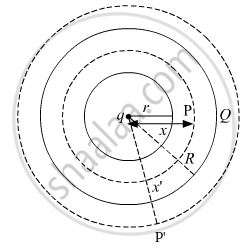
To calculate the electric field intensity at any point P', where point P' lies outside of the spherical shell, imagine a Gaussian surface with centre O and radius x', as shown in the figure given above.
According to Gauss's theorem,
` E' xx 4πx^'2 = (q+Q)/ε_0 `
⇒`E = (q+Q)/(4πx'^ 2 )`
As the charge always resides only on the outer surface of a conduction shell, the charge flows essentially from the sphere to the shell when they are connected by a wire. It does not depend on the magnitude and sign of charge Q.
