Advertisements
Advertisements
प्रश्न
Find the resultant electric field due to an electric dipole of dipole moment, 2aq, (2a being the separation between the charges ±± q) at a point distant 'x' on its equator.
Advertisements
उत्तर
Consider a dipole consisting of two electric charges +q and −q between a small distance AB = 2a with centre O.
Now, let us find the electric field intensity at point P.
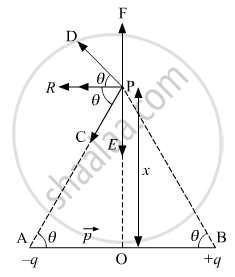
The magnitudes of the electric field at point P due to the two charges +q and −q are given by
`E_(+q) = q/(4πε_0) 1/(x^2+a^2) .....(1)`
and ` E_(-q) = q/(4πε_0) 1/(x^2+a^2) ...... (2)`
`∴ E_(+q) = E_(-q) `
The directions of E+q and E−q are as shown in the figure. The components normal to the dipole axis along PE and PF cancel away. The components along the dipole axis add up.
Therefore, the resultant electric field at point P is given as
`E = - (E_(+q) + E_(-q) cosΘ)` (The negative sign shows that the field is opposite to the dipole moment of the dipole.)
`E=(-2qa)/(4πε_0 (x^2+a^2)^(3/2)) ......(3)`
When point P lies at a large distance (x >> a) from the dipole, the above expression reduces to
`E = (-2qa)/(4πε_0 x^3 ) ....... (4)`
∴ `p =1 xx 2a`
∴ `E = (-p)/(4πε_0 x^3 )` (x >> a)
The direction of this electric field is along PR (or BA).
APPEARS IN
संबंधित प्रश्न
(i)Obtain the expression for the torque `vecτ` experienced by an electric dipole of dipole moment `vecP` in a uniform electric field, `vecE` .
(ii) What will happen if the field were not uniform?
In which orientation, a dipole placed in a uniform electric field is in (i) stable, (ii) unstable equilibrium?
An electric dipole is placed in an electric field generated by a point charge.
Answer the following question.
Derive an expression for the electric field at any point on the equatorial line of an electric dipole.
Electric charges q, q, - 2q are placed at the comers of an equilateral triangle ABC of side l. The magnitude of electric dipole moment of the system is ____________.
In a non-uniform electric field, electric dipole experiences:-
A square surface of side l (m) in the plane of the paper. A uniform electric field E(V/m) also in the plane of the paper is limited only to the lower half of the square surface, the electric flux (in SI units) associated with the surface is ______.
For the configuration with +0.25 μC at (0, 0, −15 cm) and −0.25 μC at (0, 0, +15 cm), the direction of the dipole moment is:
