Advertisements
Advertisements
Question
A system has two charges qA = 2.5 × 10⁻⁷ C and qB = −2.5 × 10⁻⁷ C located at points A: (0, 0, − 15 cm) and B: (0, 0, + 15 cm), respectively. What are the total charge and electric dipole moment of the system?
Advertisements
Solution
Both the charges can be located in a coordinate frame of reference as shown in the given figure.
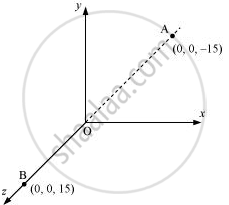
At A, amount of charge, qA = 2.5 × 10⁻⁷C
At B, amount of charge, qB = −2.5 × 10⁻⁷ C
Total charge of the system,
q = qA + qB
= 2.5 × 10⁷ C + (− 2.5 × 10⁻⁷) C
= 0
Distance between two charges at points A and B,
d = 15 + 15 = 30 cm = 0.3 m
Electric dipole moment of the system is given by,
p = qA × d = qB × d
= 2.5 × 10−7 × 0.3
= 7.5 × 10⁻⁸ C m along positive z-axis
Therefore, the electric dipole moment of the system is 7.5 × 10⁻⁸ C m along positive z−axis.
APPEARS IN
RELATED QUESTIONS
An electric dipole of length 4 cm, when placed with its axis making an angle of 60° with a uniform electric field, experiences a torque of `4sqrt3`Nm. Calculate the potential energy of the dipole, if it has charge ±8 nC
Derive the expression for the electric potential due to an electric dipole at a point on its axial line.
Depict the equipotential surfaces due to an electric dipole.
Find the resultant electric field due to an electric dipole of dipole moment, 2aq, (2a being the separation between the charges ±± q) at a point distant 'x' on its equator.
In which orientation, a dipole placed in a uniform electric field is in (i) stable, (ii) unstable equilibrium?
Three charges are arranged on the vertices of an equilateral triangle, as shown in the figure. Find the dipole moment of the combination.
Answer the following question.
What is the unit of dipole moment?
A metal sphere of radius 1 cm is given a charge of 3.14 µC. Find the electric intensity at a distance of 1 m from the centre of sphere.
`[epsilon_0 = 8.85 xx 10^-12 "F"//m]`
When an electric dipole p is placed in a uniform electric field E then at what angle the value of torque will be maximum?
Dimensions of mass in electric field and in electric dipole moment are respectively.
The ratio of the weight of a man in a stationary lift and in a lift accelerating downwards with a uniform acceleration α is 3 : 2. The acceleration of the lift is:
The electric intensity due to a dipole of length 10 cm and having a charge of 500 µC, at a point on the axis at a distance 20 cm from one of the charges in air, is:
An electric dipole of moment `vec"p"` is placed normal to the lines of force of electric intensity `vec"E"`, then the work done in deflecting it through an angle of 180° is:
A dipole is placed in an electric field as shown. In which direction will it move?

The electric potential V as a function of distance X is shown in the figure.
The graph of the magnitude of electric field intensity E as a function of X is ______.
What work must be done to rotate an electric dipole through an angle θ with the electric field, if an electric dipole of moment p is placed in a uniform electric field E with p parallel to E?
Show that intensity of electric field at a point in broadside position of an electric dipole is given by:
E = `(1/(4 pi epsilon_0)) p/((r^2 + l^2)^(3//2))`
Where the terms have their usual meaning.
Arrangement of an oxygen ion and two hydrogen ions in a water molecule is shown in the figure below.
Calculate the electric dipole moment of a water molecule. Express your answer in terms of e (charge on hydrogen ions), l and θ.

