Advertisements
Advertisements
प्रश्न
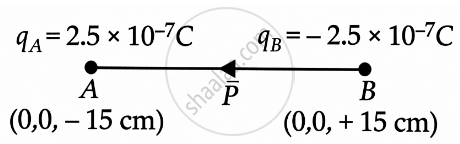
A system has two charges qA = 2.5 × 10⁻⁷ C and qB = −2.5 × 10⁻⁷ C located at points A: (0, 0, −15 cm) and B: (0, 0, +15 cm), respectively. What are the total charge and electric dipole moment of the system?
Advertisements
उत्तर
qnet = qA + qB
qnet = 2.5 × 10⁻⁷ + (−2.5 × 10⁻⁷)
= 2.5 × 10⁻⁷ − 2.5 × 10−7
= 0
Distance between two charges at points A and B,
d = 15 + 15
= 30 cm
= 0.3 m
The electric dipole moment of the system is given by,
p = qA × d = qB × d
= 2.5 × 10−7 × 0.3
= 7.5 × 10⁻⁸ C m directed along BA
संबंधित प्रश्न
Drive the expression for electric field at a point on the equatorial line of an electric dipole.
Depict the orientation of the dipole in (i) stable, (ii) unstable equilibrium in a uniform electric field.
Depict the equipotential surfaces due to an electric dipole.
Write the expression for the torque \[\vec{\tau}\] acting on a dipole of dipole moment \[\vec{p}\] placed in an electric field \[\vec{E}\].
Define electric dipole moment. Is it a scalar or a vector? Derive the expression for the electric field of a dipole at a point on the equatorial plane of the dipole.
A sample of HCI gas is placed in an electric field of 2.5 × 10⁴ NC−1. The dipole moment of each HCI molecule is 3.4 × 10⁻³⁰ Cm. Find the maximum torque that can act on a molecule.
In an electric dipole, at which point is the electric potential zero ?
Answer the following question.
Derive an expression for the electric field at any point on the equatorial line of an electric dipole.
Answer the following question.
What is the unit of dipole moment?
An electric dipole consists of two opposite charges each 0.05 µC separated by 30 mm. The dipole is placed in an unifom1 external electric field of 106 NC-1. The maximum torque exerted by the field on the dipole is ______
A uniform electric field is prevailing in X - direction in certain region. The coordinates of points P, Q, and R are (0, 0), (2, 0) and (0, 2) respectively. Which of the following alternatives is true for the potentials at these points?
Dimensions of mass in electric field and in electric dipole moment are respectively.
A conic surface is placed in a uniform electric field E as shown in the figure such that the field is perpendicular to the surface on the side AB. The base of the cone is of radius R, and the height of the cone is h. The angle of the cone is θ.
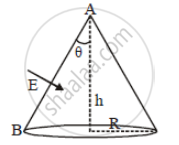
Find the magnitude of the flux that enters the cone's curved surface from the left side. Do not count the outgoing flux (θ < 45°)
Electric dipole consists of two charges of magnitude 0.1 µC separated by a distance of 2 cm. The dipole is in 5 an external field of 105 N/C. What maximum torque does the field exert on the dipole?
Polar molecules are the molecules ______.
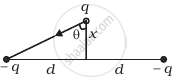
Two charges –q each are fixed separated by distance 2d. A third charge q of mass m placed at the mid-point is displaced slightly by x(x << d) perpendicular to the line joining the two fixed charged as shown in figure. Show that q will perform simple harmonic oscillation of time period.
`T = [(8pi^3 ε_0 md^3)/q^2]^(1/2)`
The electric potential V as a function of distance X is shown in the figure.
The graph of the magnitude of electric field intensity E as a function of X is ______.
