Advertisements
Advertisements
प्रश्न
Depict the orientation of the dipole in (i) stable, (ii) unstable equilibrium in a uniform electric field.
Advertisements
उत्तर
Depicting the orientation of the dipole in
(i) stable equilibrium in a uniform electric field
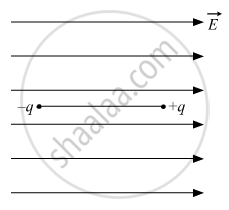
Net force is zero in this case as qE - qE = 0
Net torque = pEsinθ as θ = 0°
(ii) unstable equilibrium in a uniform electric field.
Net force is negative in this case as - qE - qE = -2qE
Net torque = pEsinθ as θ = 180°
APPEARS IN
संबंधित प्रश्न
An electric dipole of length 4 cm, when placed with its axis making an angle of 60° with a uniform electric field, experiences a torque of `4sqrt3`Nm. Calculate the potential energy of the dipole, if it has charge ±8 nC
A uniform electric field is prevailing in X - direction in certain region. The coordinates of points P, Q, and R are (0, 0), (2, 0) and (0, 2) respectively. Which of the following alternatives is true for the potentials at these points?
When an electric dipole p is placed in a uniform electric field E then at what angle the value of torque will be maximum?
An electric dipole is placed at an angle of 30° to a non-uniform electric field. The dipole will experience ________.
Arrangement of an oxygen ion and two hydrogen ions in a water molecule is shown in the figure below.
Calculate the electric dipole moment of a water molecule. Express your answer in terms of e (charge on hydrogen ions), l and θ.

The SI unit of electric dipole moment is:
In the derivation of the electric field at the equatorial line, why do the components perpendicular to the dipole axis cancel out?
Carbon dioxide (CO₂) has zero net dipole moment even though it contains polar C=O bonds. Why?
