Advertisements
Advertisements
प्रश्न
A system has two charges qA = 2.5 × 10⁻⁷ C and qB = −2.5 × 10⁻⁷ C located at points A: (0, 0, − 15 cm) and B: (0, 0, + 15 cm), respectively. What are the total charge and electric dipole moment of the system?
Advertisements
उत्तर
Both the charges can be located in a coordinate frame of reference as shown in the given figure.
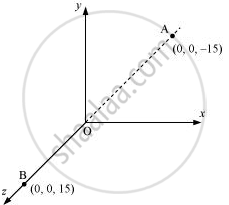
At A, amount of charge, qA = 2.5 × 10⁻⁷C
At B, amount of charge, qB = −2.5 × 10⁻⁷ C
Total charge of the system,
q = qA + qB
= 2.5 × 10⁷ C + (− 2.5 × 10⁻⁷) C
= 0
Distance between two charges at points A and B,
d = 15 + 15 = 30 cm = 0.3 m
Electric dipole moment of the system is given by,
p = qA × d = qB × d
= 2.5 × 10−7 × 0.3
= 7.5 × 10⁻⁸ C m along positive z-axis
Therefore, the electric dipole moment of the system is 7.5 × 10⁻⁸ C m along positive z−axis.
APPEARS IN
संबंधित प्रश्न
An electric dipole of dipole moment`vecp` consists of point charges +q and −q separated by a distance 2a apart. Deduce the expression for the electric field `vecE` due to the dipole at a distance x from the centre of the dipole on its axial line in terms of the dipole moment `vecp`. Hence show that in the limit x>> a, `vecE->2vecp"/"(4piepsilon_0x^3)`
Drive the expression for electric field at a point on the equatorial line of an electric dipole.
Derive the expression for the electric potential due to an electric dipole at a point on its axial line.
In an electric dipole, at which point is the electric potential zero ?
A short electric dipole bas a dipole moment of 16 x 10-9 C m. The electric potential due to the dipole at a point at a distance of 0.6 m from the centre of the dipole, situated on a line making an angle of 60° with the dipole axis is: ____________. `(1/(4piepsilon_0) = 9 xx 10^9 "Nm"^2// "C"^2)`
Electric field on the axis of a small electric dipole at a distance r is E1 and at a distance of 2r on its perpendicular bisector, the electric field is E2. Then the ratio E2: E1 is ______.
A conic surface is placed in a uniform electric field E as shown in the figure such that the field is perpendicular to the surface on the side AB. The base of the cone is of radius R, and the height of the cone is h. The angle of the cone is θ.
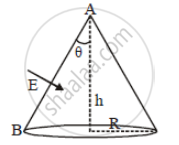
Find the magnitude of the flux that enters the cone's curved surface from the left side. Do not count the outgoing flux (θ < 45°)
The electric intensity due to a dipole of length 10 cm and having a charge of 500 µC, at a point on the axis at a distance 20 cm from one of the charges in air, is:
An electric dipole of moment `vec"p"` is placed normal to the lines of force of electric intensity `vec"E"`, then the work done in deflecting it through an angle of 180° is:
The region surrounding a stationary electric dipole has ______
Electric dipole consists of two charges of magnitude 0.1 µC separated by a distance of 2 cm. The dipole is in 5 an external field of 105 N/C. What maximum torque does the field exert on the dipole?
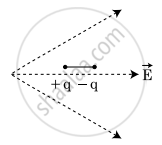
A dipole is placed in an electric field as shown. In which direction will it move?
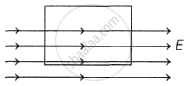
A square surface of side l (m) in the plane of the paper. A uniform electric field E(V/m) also in the plane of the paper is limited only to the lower half of the square surface, the electric flux (in SI units) associated with the surface is ______.
Show that intensity of electric field at a point in broadside position of an electric dipole is given by:
E = `(1/(4 pi epsilon_0)) p/((r^2 + l^2)^(3//2))`
Where the terms have their usual meaning.
