Advertisements
Advertisements
प्रश्न
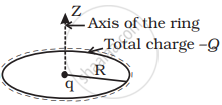
Total charge –Q is uniformly spread along length of a ring of radius R. A small test charge +q of mass m is kept at the centre of the ring and is given a gentle push along the axis of the ring.
- Show that the particle executes a simple harmonic oscillation.
- Obtain its time period.
Advertisements
उत्तर
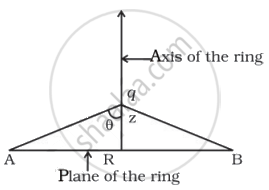
a. Slight push on q along the axis of the ring gives rise to the situation shown in figure. A and B are two points on the ring at the end of a diameter.
Force on q due to line elements `(-Q)/(2piR)` at A and B is
`F_(A + B) = 2 * (-Q)/(2piR) * q * 1/(4piε_0) * 1/r^2 * cos theta`
= `(-Qq)/(piR.4piε_0) * 1/((z^2 + R^2)) * Z/(z^2 + R^2)^(1/2)`
Total force due to ring on q = `(F_(A + B))(piR)`
= `(-Qq)/(4piε_0) z/(z^2 + R^2)^(3/2)`
= `(-Qq)/(4piε_0)` for z << R
Thus, the force is proportional to the negative displacement. Motion under such forces is harmonic.
b. From (a)
`m (d^2z)/(dt^2) = - (Qqz)/(4piε_0R^3)` or `(d^2z)/(dt^2) = - (Qq)/(4piε_0mR^3)z`
That is `ω^2 = (Qq)/(4piε_0mR^3)`. Hence T = `2pisqrt((4piε_0mR)/(Qq))`
