Topics
Electric Charges and Fields
- Electric Charge
- Conductors and Insulators
- Properties of Electric Charge
- Coulomb’s Law
- Forces between Multiple Charges
- Electric Field
- Electric Field Due to a System of Charges
- Physical Significance of Electric Field
- Electric Field Lines
- Electric Flux
- Electric Dipole
- Dipole in a Uniform External Field
- Continuous Charge Distribution
- Gauss’s Law
- Application of Gauss' Law
Electrostatics
Current Electricity
Electrostatic Potential and Capacitance
- Electric Potential and Potential Energy
- Electrostatic Potential
- Electric Potential Due to a Point Charge
- Potential Due to an Electric Dipole
- Potential due to a System of Charges
- Equipotential Surfaces
- Relation Between Electric Field and Electrostatic Potential
- Potential Energy of a System of Charges
- Potential Energy of a Single Charge
- Potential Energy of a System of Two Charges in an External Field
- Potential Energy of a Dipole in an External Field
- Electrostatics of Conductors
- Dielectrics and Polarisation
- Capacitors and Capacitance
- The Parallel Plate Capacitor
- Effect of Dielectric on Capacitance
- Combination of Capacitors
- Energy Stored in a Charged Capacitor
Magnetic Effects of Current and Magnetism
Current Electricity
- Electric Current
- Electric Currents in Conductors
- Ohm's Law
- Drift of Electrons and the Origin of Resistivity
- Mobility of Electrons
- Limitations of Ohm’s Law
- Resistivity of Various Materials
- Temperature Dependence of Resistivity
- Electrical Energy and Power in Conductors
- Cells, EMF, and Internal Resistance
- Cells in Series and in Parallel
- Kirchhoff’s Laws
- Wheatstone Bridge
Electromagnetic Induction and Alternating Currents
Moving Charges and Magnetism
- Electromagnetism
- Magnetic force
- Motion in a Magnetic Field
- Magnetic Field Due to a Current-carrying Conductor: Biot-savart's Law
- Applications of Biot-Savart's Law > Magnetic Field at the Axis of a Circular Current-carrying Loop
- Ampere’s Circuital Law
- Solenoid
- Force Between Two Parallel Currents (Ampere’s Law)
- Torque on a Rectangular Current Loop in a Uniform Magnetic Field
- Circular Current Loop as a Magnetic Dipole
- Moving Coil Galvanometer
- Kirchhoff’s Laws
Magnetism and Matter
Electromagnetic Waves
Electromagnetic Induction
Optics
Alternating Current
Dual Nature of Radiation and Matter
Electromagnetic Waves
Atoms and Nuclei
Ray Optics and Optical Instruments
- Ray Optics Or Geometrical Optics
- Reflection of Light by Spherical Mirrors
- Sign Convention for Reflection by Spherical Mirrors
- Focal Length of Spherical Mirrors
- Mirror Equation of Spherical Mirrors
- Refraction of Light
- Total Internal Reflection
- Applications of Total Internal Reflection
- Refraction at a Spherical Surfaces
- Refraction by a Lens
- Power of a Lens
- Combined Focal Length of Two Thin Lenses in Contact
- Refraction Through a Prism
- Introduction to Optical Instruments
- Microscope and it’s types
- Telescope
Electronic Devices
Communication Systems
Wave Optics
- Introduction to Wave Optics
- Huygens Principle
- Refraction of a Plane Wave
- Refraction at a Rarer Medium
- Reflection of a Plane Wave by a Plane Surface
- Coherent and Incoherent Addition of Waves
- Interference of Light Waves and Young’s Experiment
- Diffraction of Light
- The Single Slit
- Seeing the Single Slit Diffraction Pattern
- Polarisation of Light
Dual Nature of Radiation and Matter
- Understanding Dual Nature of Radiation and Matter
- Electron Emission
- Photoelectric Effect - Hertz’s Observations
- Photoelectric Effect - Hallwachs’ and Lenard’s Observations
- Experimental Study of Photoelectric Effect
- Effects of Intensity and Frequency on Photocurrent
- Photoelectric Effect and Wave Theory of Light
- Einstein’s Photoelectric Equation: Energy Quantum of Radiation
- Particle Nature of Light: The Photon
- Wave Nature of Matter
The Special Theory of Relativity
Atoms
Nuclei
Semiconductor Electronics - Materials, Devices and Simple Circuits
Communication Systems
- Detection of Amplitude Modulated Wave
- Production of Amplitude Modulated Wave
- Basic Terminology Used in Electronic Communication Systems
- Sinusoidal Waves
- Modulation and Its Necessity
- Amplitude Modulation (AM)
- Need for Modulation and Demodulation
- Satellite Communication
- Propagation of EM Waves
- Bandwidth of Transmission Medium
- Bandwidth of Signals
The Special Theory of Relativity
- The Special Theory of Relativity
- The Principle of Relativity
- Maxwell'S Laws
- Kinematical Consequences
- Dynamics at Large Velocity
- Energy and Momentum
- The Ultimate Speed
- Twin Paradox
Definition: Resonance
Resonance in a series LCR circuit is the phenomenon that occurs at a particular frequency at which the amplitude of current is maximum. This happens when the inductive reactance equals the capacitive reactance: XC = XL.
Derivation of Resonant Frequency
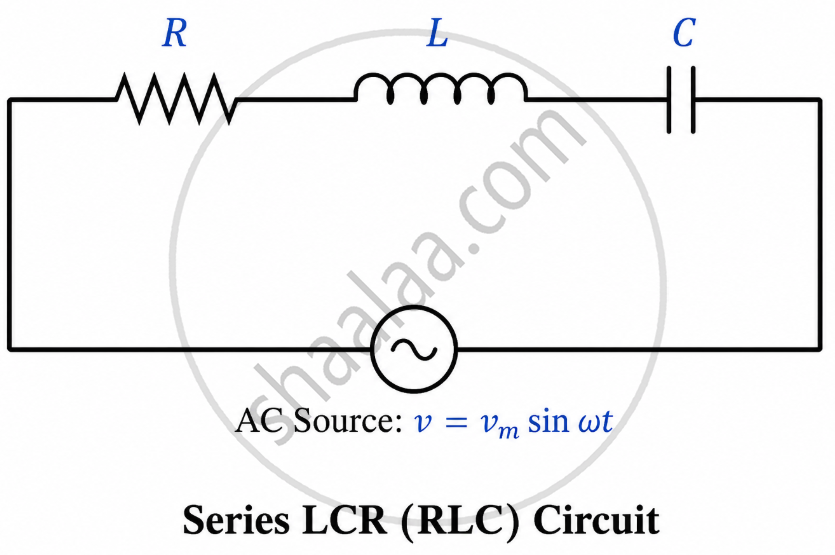
Step 1: Current amplitude in series LCR circuit:
- im = \[\frac {v_m}{Z}\]
where impedance:
- Z = \[\sqrt {R^2+(X_C−X_L)^2}\]
Step 2: Condition for maximum current:
For im to be maximum, Z must be minimum.
Z is minimum when:
- (XC − XL) = 0 ⇒ XC = XL
Step 3: Minimum impedance at resonance:
- Zmin = \[\sqrt {R^2+0}\] = R
Step 4: Finding resonant frequency:
- XC = XL
- \[\frac {1}{ω_0C}\] = \[ω_0L\]
- \[ω_0^2\] = \[\frac {1}{LC}\]
- ω0 = \[\frac {1}{\sqrt {LC}}\]
Step 5: Maximum current at resonance:
- \[{i_{max} = \frac{v_m}{R}}\]
Key Results at Resonance
| Quantity | At Resonance | Reason |
|---|---|---|
| Condition | \[X_C = X_L\] | Inductive and capacitive reactances are equal and cancel each other. |
| Impedance | Z = R (minimum) | Since (\[X_C = X_L\]) = 0, the impedance is reduced to the resistance alone. |
| Current | \[i_m = \dfrac{v_m}{R}\] (maximum) | The impedance is minimum; therefore, the circuit current is maximum. |
| Nature of Circuit | Purely resistive | There is no net reactance, so voltage and current are in phase. |
Example
Given: RC series circuit with:
- R = 200 Ω
- C = 15.0 μF = 15.0 × 10⁻⁶ F
- AC source: 220 V, 50 Hz
Find: (a) Current in the circuit, (b) Voltage across R, (c) Voltage across C
Step 1: Angular frequency:
- ω = 2πf = 2π × 50 = 314.16 rad/s
Step 2: Capacitive reactance:
- XC = \[\frac{1}{\omega C}=\frac{1}{314.16\times15\times10^{-6}}\] ≈ 212.2Ω
Step 3: Impedance (RC circuit, no inductor):
- Z = \[\sqrt{R^2+X_C^2}=\sqrt{(200)^2+(212.2)^2}=\sqrt{40000+45029}\] ≈ 291.7Ω
Step 4: RMS Current:
- I = \[\frac{V_{rms}}{Z}=\frac{220}{291.7}\] ≈ 0.755A
Step 5: Voltage across R:
- VR = IR = 0.755 × 200 = 151 V
Step 6: Voltage across C:
- VC = IXC = 0.755 × 212.2 ≈ 160.3 V
Step 7: Verification using phasor addition:
- V = \[\sqrt{V_R^2+V_C^2}=\sqrt{(151)^2+(160.3)^2}=\sqrt{22801+25696}\] ≈ 220V
Real-Life Analogy - The Swing
Think of a child being pushed on a swing.
| Swing (Mechanical) | LCR Circuit (Electrical) |
|---|---|
| The swing has a natural frequency of oscillation. | The LCR circuit has a natural resonant frequency \[\omega_0\]. |
| Pushing the swing at its natural frequency produces the maximum amplitude of oscillation. | Driving the LCR circuit at \[\omega_0\] produces the maximum current (resonance). |
| Friction limits the maximum amplitude of the swing. | Resistance (R) limits the maximum current in the circuit. |
