Topics
Electric Charges and Fields
- Electric Charges
- Conductors and Insulators
- Properties of Electric Charge
- Coulomb’s Law
- Forces between Multiple Charges
- Electric Field
- Electric Field Due to a System of Charges
- Physical Significance of Electric Field
- Electric Field Lines
- Electric Flux
- Electric Dipole
- Dipole in a Uniform External Field
- Continuous Charge Distribution
- Gauss’s Law
- Application of Gauss' Law
Electrostatics
Current Electricity
Electrostatic Potential and Capacitance
- Electric Potential and Potential Energy
- Electrostatic Potential
- Electric Potential Due to a Point Charge
- Potential Due to an Electric Dipole
- Potential due to a System of Charges
- Equipotential Surfaces
- Relation Between Electric Field and Electrostatic Potential
- Potential Energy of a System of Charges
- Potential Energy of a Single Charge
- Potential Energy of a System of Two Charges in an External Field
- Potential Energy of a Dipole in an External Field
- Electrostatics of Conductors
- Dielectrics and Polarisation
- Capacitors and Capacitance
- The Parallel Plate Capacitor
- Effect of Dielectric on Capacitance
- Combination of Capacitors
- Energy Stored in a Charged Capacitor
Magnetic Effects of Current and Magnetism
Current Electricity
- Electric Current
- Electric Currents in Conductors
- Ohm's Law
- Drift of Electrons and the Origin of Resistivity
- Mobility of Electrons
- Limitations of Ohm’s Law
- Resistivity of Various Materials
- Temperature Dependence of Resistivity
- Electrical Energy and Power in Conductors
- Cells, EMF, and Internal Resistance
- Cells in Series and in Parallel
- Kirchhoff’s Laws
- Wheatstone Bridge
Moving Charges and Magnetism
- Electromagnetism
- Magnetic force
- Motion in a Magnetic Field
- Magnetic Field Due to a Current-carrying Conductor: Biot-savart's Law
- Applications of Biot-Savart's Law > Magnetic Field at the Axis of a Circular Current-carrying Loop
- Ampere’s Circuital Law
- Solenoid
- Force Between Two Parallel Currents (Ampere’s Law)
- Torque on a Rectangular Current Loop in a Uniform Magnetic Field
- Circular Current Loop as a Magnetic Dipole
- Moving Coil Galvanometer
- Kirchhoff’s Laws
Electromagnetic Induction and Alternating Currents
Electromagnetic Waves
Magnetism and Matter
Optics
Electromagnetic Induction
Alternating Current
Dual Nature of Radiation and Matter
Atoms and Nuclei
Electromagnetic Waves
Electronic Devices
Ray Optics and Optical Instruments
- Ray Optics Or Geometrical Optics
- Reflection of Light by Spherical Mirrors
- Sign Convention for Reflection by Spherical Mirrors
- Focal Length of Spherical Mirrors
- Mirror Equation of Spherical Mirrors
- Refraction of Light
- Total Internal Reflection
- Applications of Total Internal Reflection
- Refraction at a Spherical Surfaces
- Refraction by a Lens
- Power of a Lens
- Combined Focal Length of Two Thin Lenses in Contact
- Refraction of Light through a Prism
- Introduction to Optical Instruments
- Microscope and it’s types
- Telescope
Wave Optics
- Introduction to Wave Optics
- Huygens Principle
- Refraction of a Plane Wave
- Refraction at a Rarer Medium
- Reflection of a Plane Wave by a Plane Surface
- Coherent and Incoherent Addition of Waves
- Interference of Light Waves and Young’s Experiment
- Diffraction of Light
- The Single Slit
- Seeing the Single Slit Diffraction Pattern
- Polarisation of Light
Communication Systems
Dual Nature of Radiation and Matter
- Understanding Dual Nature of Radiation and Matter
- Electron Emission
- Photoelectric Effect - Hertz’s Observations
- Photoelectric Effect - Hallwachs’ and Lenard’s Observations
- Experimental Study of Photoelectric Effect
- Effects of Intensity and Frequency on Photocurrent
- Photoelectric Effect and Wave Theory of Light
- Einstein’s Photoelectric Equation: Energy Quantum of Radiation
- Particle Nature of Light: The Photon
- Wave Nature of Matter
The Special Theory of Relativity
Atoms
Nuclei
Semiconductor Electronics - Materials, Devices and Simple Circuits
Communication Systems
- Detection of Amplitude Modulated Wave
- Production of Amplitude Modulated Wave
- Basic Terminology Used in Electronic Communication Systems
- Sinusoidal Waves
- Modulation and Its Necessity
- Amplitude Modulation (AM)
- Need for Modulation and Demodulation
- Satellite Communication
- Propagation of EM Waves
- Bandwidth of Transmission Medium
- Bandwidth of Signals
The Special Theory of Relativity
- The Special Theory of Relativity
- The Principle of Relativity
- Maxwell'S Laws
- Kinematical Consequences
- Dynamics at Large Velocity
- Energy and Momentum
- The Ultimate Speed
- Twin Paradox
Maharashtra State Board: Class 11
Definition: Gaussian Surface
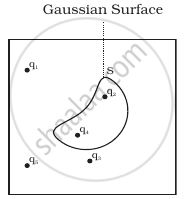
A Gaussian surface is an imaginary, closed mathematical surface chosen to apply Gauss's Law conveniently.
Maharashtra State Board: Class 11
CISCE: Class 12
Properties of a Gaussian Surface
- It is not a real physical surface — it is purely mathematical
- Can be any shape (sphere, cylinder, pillbox, cube)
- Chosen such that E is either uniform and parallel to dS, or perpendicular to dS, at all points
- Must completely enclose the charge distribution of interest
How to Choose the Right Gaussian Surface
| Charge Distribution | Symmetry Type | Ideal Gaussian Surface |
|---|---|---|
| Point charge / Spherical shell | Spherical | Concentric sphere |
| Infinite line charge / Cylinder | Cylindrical | Co-axial cylinder |
| Infinite plane sheet | Planar | Pillbox (short cylinder) |
Maharashtra State Board: Class 11
CISCE: Class 12
Statement of Gauss's Law
"The total electric flux through any closed surface is equal to \[\frac {1}{ε_0}\] times the net charge enclosed by that surface."
Three Forms of the Law
1. Verbal Form:
The net outward electric flux through a closed surface equals the net enclosed charge divided by ε₀.
2. Algebraic Form:
ΦE = \[\frac {Q_enc}{ε_0}\]
3. Integral Form:
\[\oint\vec{E}\cdot d\vec{S}=\frac{Q_{\mathrm{enc}}}{\varepsilon_0}\]
Variable Legend
| Symbol | Meaning | SI Unit |
|---|---|---|
| ∮ | Closed surface integral | — |
| E | Electric field at the surface | N C⁻¹ |
| dS | Area element vector (outward normal) | m² |
| Qenc | Net charge enclosed by the surface | Coulomb (C) |
| ε0 | Permittivity of free space = 8.85 × 10⁻¹² C² N⁻¹ m⁻² | C² N⁻¹ m⁻² |
Maharashtra State Board: Class 11
CISCE: Class 12
Physical Interpretation & Analogy
Real-Life Analogy
Imagine holding a fishing net around a sprinkler head. The number of water streams passing through the net depends only on how many sprinkler heads are inside — not on the shape or size of the net.
Similarly, the electric flux through any closed surface depends only on the charge enclosed — not on the shape of the surface or charges outside it.
Intuitive Meaning
- More charge inside → More field lines → Greater flux
- Zero charge inside → Field lines enter and exit equally → Net flux = 0
- Charges outside the surface do not contribute to the net flux
CISCE: Class 12
Applications of Gauss's Law
Application 1 — Electric Field due to an Infinitely Long Straight Wire
Linear charge density = λ (C/m), find E at distance r from wire.
Gaussian Surface: Co-axial cylinder of radius r and length l.
Derivation:
Flux through the two flat ends = 0 (E ⊥ dS on flat faces)
Φ = E × 2πrl
Enclosed charge: Qenc = λl
Applying Gauss's Law:
E × 2πrl = \[\frac {λl}{ε_0}\]
E = \[\frac {λ}{2πε_0r}\]
Direction: Radially outward (for +λ), radially inward (for −λ)
Application 2 — Electric Field due to a Uniformly Charged Infinite Plane Sheet
Surface charge density = σ (C/m²), find E at perpendicular distance from sheet.
Gaussian Surface: Pillbox (short cylinder) straddling the sheet.
Derivation:
Flux through curved part = 0; flux through two flat faces:
Φ = 2E A
Enclosed charge: Qenc = σ A
2EA = \[\frac {σA}{ε_0}\]
E = \[\frac {σ}{2ε_0}\]
Note: E is independent of the distance from the plane sheet — it remains constant everywhere!
Direction: Normal to plane, outward (for +σ); inward (for −σ)
Application 3 — Electric Field due to a Uniformly Charged Thin Spherical Shell
Total charge Q on a spherical shell of radius R, find E at distance r from the centre.
Gaussian Surface: Concentric sphere of radius r.
Case (a): Outside the shell (r > R)
E × 4πr2 = \[\frac {Q}{ε_0}\]
E = \[\frac {1}{4πε_0}\] ⋅ \[\frac {Q}{r^2}\] (r>R)
Shell behaves like a point charge at its centre.
Case (b): On the surface (r = R)
\[{E=\frac{1}{4\pi\varepsilon_0}\cdot\frac{Q}{R^2}}\]
Case (c): Inside the shell (r < R)
Enclosed charge = 0, therefore:
E = 0 (r < R)
Key Result: The electric field inside a uniformly charged spherical shell is zero everywhere.
Summary Table
| Charge Distribution | Gaussian Surface | Key Formula | Notes |
|---|---|---|---|
| Infinite line charge (λ) | Co-axial cylinder | E = \[\frac{\lambda}{2\pi\varepsilon_0r}\] | E ∝ 1/r |
| Infinite plane sheet (σ) | Pillbox | E = \[\frac{\sigma}{2\varepsilon_{0}}\] | E = constant (no r dependence) |
| Spherical shell (Q), outside | Concentric sphere | E = \[\frac{Q}{4\pi\varepsilon_0r^2}\] | Acts like a point charge |
| Spherical shell (Q), inside | Concentric sphere | E = 0 | No enclosed charge |
Example 1
Flux through a sphere enclosing a charge
Data
- Charge at centre: q = 5.0 C.
- Radius of sphere: R = 1.0 m (later doubled).
Result
- Flux through the sphere: ΦE = \[\frac {q}{ε_0}\]
- This is independent of R.
- If R is doubled, E decreases as 1/R2, area increases as R2, and the product remains the same.
- So total flux remains q/ε0.
Example 2
Cube in a non‑uniform field
Field
- Ex = αx1/2, Ey = 0, Ez = 0, with α = 800 N C−1m−1/2.
- Cube of side a = 0.1 m.
Flux
- Only two faces (perpendicular to x) contribute to flux; others are perpendicular to E.
- Field on left face: EL = αa1/2.
- Field on right face: ER = α(2a)1/2.
- Flux: Φ = a2(ER − EL) = αa5/2(\[\sqrt 2\] − 1) ≈ 1.05 N m2C−1
Charge enclosed
-
From Gauss’s law: qenclosed = ε0Φ ≈ 9.27 × 10⁻¹² C
Example 3
Cylinder in a piecewise-uniform field
Field
- For x > 0: \[\vec E\] = +200 \[\hat i\] N C−1.
- For x < 0: \[\vec E\] = −200 \[\hat i\] N C−1.
Cylinder
- Radius 0.05 m, length 0.20 m, axis along x, centre at origin.
- Faces at x = +0.10 m and x = −0.10 m.
Flux
- Curved surface: E ⟂ dS ⇒ flux = 0.
- Left face (x < 0): ΦL = +200 × π(0.05)2 ≈ 1.57 N m2C−1
- Right face (x > 0): ΦR = +200 × π(0.05)2 ≈ 1.57 N m2C−1
- Net flux: Φ = ΦL + ΦR = 3.14 N m2C−1
Charge enclosed
-
From Gauss’s law: qenclosed = ε0Φ ≈ 2.78 × 10⁻¹¹ C
Maharashtra State Board: Class 11
CISCE: Class 12
Key Points: Gauss's Law
- Applicable to any closed surface, regardless of shape or size — sphere, cube, irregular shape
- Only enclosed charges contribute to the net flux; external charges do not
- The electric field E at the Gaussian surface is due to all charges (inside and outside), but the net flux depends only on enclosed charge
- Gauss's Law is valid for both stationary and moving charges
- It is one of Maxwell's four equations of electromagnetism
- Gauss's Law can be derived from Coulomb's Law for static charges, and vice versa — both are equivalent
- If net enclosed charge = 0, net flux = 0 (but E ≠ 0 necessarily)