Advertisements
Advertisements
प्रश्न
State Gauss’s law for magnetism. Explain its significance.
Advertisements
उत्तर
Gauss's law of magnetism states that net magnetic flux through a closed surface (Gaussian surface) is zero. Mathematically
`oint vecB.dvecs = 0`
Gauss’s Law for magnetism tells us that magnetic monopoles do not exist
APPEARS IN
संबंधित प्रश्न
A charge ‘q’ is placed at the centre of a cube of side l. What is the electric flux passing through each face of the cube?
q1, q2, q3 and q4 are point charges located at points as shown in the figure and S is a spherical gaussian surface of radius R. Which of the following is true according to the Gauss' law?

The Electric flux through the surface
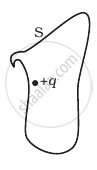 (i) |
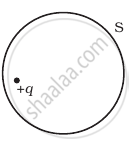 (ii) |
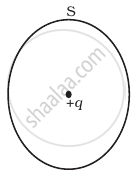 (iii) |
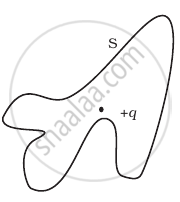 (iv) |
If there were only one type of charge in the universe, then ______.
- `oint_s` E.dS ≠ 0 on any surface.
- `oint_s` E.dS = 0 if the charge is outside the surface.
- `oint_s` E.dS could not be defined.
- `oint_s` E.dS = `q/ε_0` if charges of magnitude q were inside the surface.
Consider a region inside which there are various types of charges but the total charge is zero. At points outside the region
- the electric field is necessarily zero.
- the electric field is due to the dipole moment of the charge distribution only.
- the dominant electric field is `∞ 1/r^3`, for large r, where r is the distance from a origin in this region.
- the work done to move a charged particle along a closed path, away from the region, will be zero.
What is the SI unit of permittivity of free space (ε₀)?
In the context of Gauss's Law, what does the area element vector dS represent?
For an infinite line charge with linear charge density λ, which Gaussian surface is most appropriate?
