Advertisements
Advertisements
प्रश्न
State and explain Gauss’s law.
Advertisements
उत्तर
Gauss’s law states that the flux of the electric field through any closed surface S is 1/∈ₒ times the total charge enclosed by S
Let the total flux through a sphere of radius r enclose a point charge q at its centre. Divide the sphere into a small area element as shown in the figure.
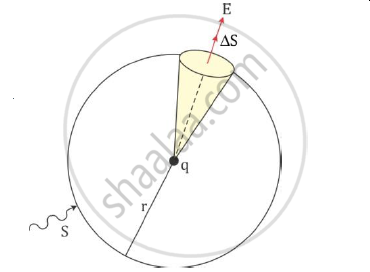
The flux through an area element ΔS is
`Deltaphi=E.DeltaS=q/(4piin_0r^2)hatr.DeltaS`
Here, we have used Coulomb’s law for the electric field due to a single charge q.
The unit vector `hatr`is along the radius vector from the centre to the area element. Because the normal to a sphere at every point is along the radius vector at that point, the area element ΔS and `hatr` have the same direction. Therefore
`Deltaphi=q/(4piin_0r^2)DeltaS`
Because the magnitude of the unit vector is 1, the total flux through the sphere is obtained by adding the flux through all the different area elements.
`phi=sum_(all DeltaS)q/(4piin_0r^2)DeltaS`
Because each area element of the sphere is at the same distance r from the charge,
`phi=q/(4piin_0r^2)sum_(all DeltaS)DeltaS=q/(4piin_0r^2)S`
Now, S the total area of the sphere equals 4πr². Thus,
`pi=q/(4piin_0r^2)xx4pir^2=q/in_0`
Hence, the above equation is a simple illustration of a general result of electrostatics called Gauss’s law
APPEARS IN
संबंधित प्रश्न
Draw a graph of electric field E(r) with distance r from the centre of the shell for 0 ≤ r ≤ ∞.
Answer the following question.
State Gauss's law for magnetism. Explain its significance.
The surface considered for Gauss’s law is called ______.
Gauss' law helps in ______
Refer to the arrangement of charges in figure and a Gaussian surface of radius R with Q at the centre. Then

- total flux through the surface of the sphere is `(-Q)/ε_0`.
- field on the surface of the sphere is `(-Q)/(4 piε_0 R^2)`.
- flux through the surface of sphere due to 5Q is zero.
- field on the surface of sphere due to –2Q is same everywhere.
A charge of +5 μC is placed at the centre of two concentric spheres of radii r1 = 3 cm and r2 = 5 cm. The ratio of the flux through sphere of radius r1 to that through sphere of radius r2 will be ______.
For a Gaussian surface to be convenient for calculations, the electric field should be:
According to Gauss's Law, the total electric flux through a closed surface depends on:
In the context of Gauss's Law, what does the area element vector dS represent?
For a uniformly charged thin spherical shell, what is the electric field at any point inside the shell (r < R)?
