Advertisements
Advertisements
प्रश्न
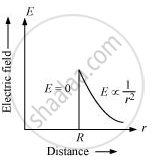
Draw a graph of electric field E(r) with distance r from the centre of the shell for 0 ≤ r ≤ ∞.
Advertisements
उत्तर
The graph of electric field E(r) with distance r from the centre of the shell for 0 ≤ r ≤ ∞.
APPEARS IN
संबंधित प्रश्न
State and explain Gauss’s law.
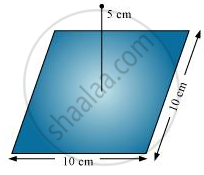
A point charge +10 μC is a distance 5 cm directly above the centre of a square of side 10 cm, as shown in the Figure. What is the magnitude of the electric flux through the square? (Hint: Think of the square as one face of a cube with edge 10 cm.)
A charge ‘q’ is placed at the centre of a cube of side l. What is the electric flux passing through each face of the cube?
A charge Q is placed at the centre of a cube. Find the flux of the electric field through the six surfaces of the cube.
The surface considered for Gauss’s law is called ______.
If `oint_s` E.dS = 0 over a surface, then ______.
- the electric field inside the surface and on it is zero.
- the electric field inside the surface is necessarily uniform.
- the number of flux lines entering the surface must be equal to the number of flux lines leaving it.
- all charges must necessarily be outside the surface.
The algebraic form of Gauss's Law is represented as:
The integral form of Gauss's Law is given by:
For a uniformly charged thin spherical shell, what is the electric field at any point inside the shell (r < R)?
In a non-uniform electric field given by \[\vec{E} = \alpha x^{1/2} \hat{i}\] with \[\alpha = 800 \text{ N C}^{-1}\text{m}^{-1/2}\], the flux through a cube of side a = 0.1 m oriented with faces perpendicular to the x-axis is approximately:
