मराठी

A Radioactive Nucleus ‘A’ Undergoes a Series of Decays According to the Following Scheme:The Mass Number and Atomic Number of a Are 180 and 72 Respectively. What Are These Numbers for A4? - Physics

Advertisements
Advertisements

प्रश्न

A radioactive nucleus ‘A’ undergoes a series of decays according to the following scheme:

The mass number and atomic number of A are 180 and 72 respectively. What are these numbers for A4?

Advertisements

उत्तर

A has mass number as 180 and atomic number 172.

Formation of A1 by α-decay:
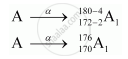
Formation of A2 by β decay:
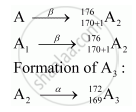
Formation of A4:

In r-decay, mass number and atomic number remain the same.

Thus,
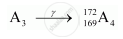
Mass number of A4 = 172

Atomic number of A4­ = 169

shaalaa.com
  या प्रश्नात किंवा उत्तरात काही त्रुटी आहे का?
2008-2009 (March) Delhi set 1

व्हिडिओ ट्यूटोरियलVIEW ALL [1]

संबंधित प्रश्‍न

Obtain the relation between the decay constant and half life of a radioactive sample.


The normal activity of living carbon-containing matter is found to be about 15 decays per minute for every gram of carbon. This activity arises from the small proportion of radioactive `""_6^14"C"` present with the stable carbon isotope `""_6^12"C"`. When the organism is dead, its interaction with the atmosphere (which maintains the above equilibrium activity) ceases and its activity begins to drop. From the known half-life (5730 years) of `""_6^14"C"` and the measured activity, the age of the specimen can be approximately estimated. This is the principle of `""_6^14"C"` dating used in archaeology. Suppose a specimen from Mohenjodaro gives an activity of 9 decays per minute per gram of carbon. Estimate the approximate age of the Indus-Valley civilisation.


Using the equation `N = N_0e^(-lambdat)` obtain the relation between half-life (T) and decay constant (`lambda`) of a radioactive substance.


Lithium (Z = 3) has two stable isotopes 6Li and 7Li. When neutrons are bombarded on lithium sample, electrons and α-particles are ejected. Write down the nuclear process taking place.


The isotope \[\ce{^57Co}\] decays by electron capture to \[\ce{^57Fe}\] with a half-life of 272 d. The \[\ce{^57Fe}\] nucleus is produced in an excited state, and it almost instantaneously emits gamma rays.
(a) Find the mean lifetime and decay constant for 57Co.
(b) If the activity of a radiation source 57Co is 2.0 µCi now, how many 57Co nuclei does the source contain?

c) What will be the activity after one year?


A source contains two species of phosphorous nuclei, \[\ce{_15^32P}\] (T1/2 = 14.3 d) and \[\ce{_15^33P}\] (T1/2 = 25.3 d). At time t = 0, 90% of the decays are from \[\ce{_15^32P}\]. How much time has to elapse for only 15% of the decays to be from \[\ce{_15^32P}\]?


The half-life of a radioactive sample undergoing `alpha` - decay is 1.4 x 10¹⁷ s. If the number of nuclei in the sample is 2.0 x 10²¹, the activity of the sample is nearly ____________.


After 1 hour, `(1/8)^"th"` of the initial mass of a certain radioactive isotope remains undecayed. The half-life of the isotopes is ______.


Consider a radioactive nucleus A which decays to a stable nucleus C through the following sequence:

A→B→C

Here B is an intermediate nuclei which is also radioactive. Considering that there are N0 atoms of A initially, plot the graph showing the variation of number of atoms of A and B versus time.


The radioactivity of an old sample of whisky due to tritium (half-life 12.5 years) was found to be only about 4% of that measured in a recently purchased bottle marked 10 years old. The age of a sample is ______ years.


Share
Notifications

Englishहिंदीमराठी


      Forgot password?
Use app×