English

A Radioactive Nucleus ‘A’ Undergoes a Series of Decays According to the Following Scheme:The Mass Number and Atomic Number of a Are 180 and 72 Respectively. What Are These Numbers for A4? - Physics

Advertisements
Advertisements

Question

A radioactive nucleus ‘A’ undergoes a series of decays according to the following scheme:

The mass number and atomic number of A are 180 and 72 respectively. What are these numbers for A4?

Advertisements

Solution

A has mass number as 180 and atomic number 172.

Formation of A1 by α-decay:
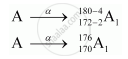
Formation of A2 by β decay:
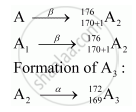
Formation of A4:

In r-decay, mass number and atomic number remain the same.

Thus,
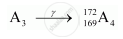
Mass number of A4 = 172

Atomic number of A4­ = 169

shaalaa.com
  Is there an error in this question or solution?
2008-2009 (March) Delhi set 1

Video TutorialsVIEW ALL [1]

RELATED QUESTIONS

The decay constant of radioactive substance is 4.33 x 10⁻⁴ per year. Calculate its half life period.


State the law of radioactive decay.


Write symbolically the process expressing the β+ decay of `""_11^22Na`. Also write the basic nuclear process underlying this decay.


Represent Radioactive Decay curve using relation `N = N_o e^(-lambdat)` graphically


In a radioactive decay, neither the atomic number nor the mass number changes. Which of the following particles is emitted in the decay?


The decay constant of `""_80^197`Hg (electron capture to `""_79^197`Au) is 1.8 × 10⁻⁴ S−1. (a) What is the half-life? (b) What is the average-life? (c) How much time will it take to convert 25% of this isotope of mercury into gold?


The half-life of 40K is 1.30 × 10⁹ y. A sample of 1.00 g of pure KCI gives 160 counts s−1. Calculate the relative abundance of 40K (fraction of 40K present) in natural potassium.


Define the term 'decay constant' of a radioactive sample. The rate of disintegration of a given radioactive nucleus is 10000 disintegrations/s and 5,000 disintegrations/s after 20 hr. and 30 hr. respectively from start. Calculate the half-life and the initial number of nuclei at t= 0. 


Samples of two radioactive nuclides A and B are taken. λA and λB are the disintegration constants of A and B respectively. In which of the following cases, the two samples can simultaneously have the same decay rate at any time?

  1. Initial rate of decay of A is twice the initial rate of decay of B and λA = λB.
  2. Initial rate of decay of A is twice the initial rate of decay of B and λA > λB.
  3. Initial rate of decay of B is twice the initial rate of decay of A and λA > λB.
  4. Initial rate of decay of B is the same as the rate of decay of A at t = 2h and λB < λA.

The radioactivity of an old sample of whisky due to tritium (half-life 12.5 years) was found to be only about 4% of that measured in a recently purchased bottle marked 10 years old. The age of a sample is ______ years.


Share
Notifications

Englishहिंदीमराठी


      Forgot password?
Use app×