हिंदी

A Radioactive Nucleus ‘A’ Undergoes a Series of Decays According to the Following Scheme:The Mass Number and Atomic Number of a Are 180 and 72 Respectively. What Are These Numbers for A4? - Physics

Advertisements
Advertisements

प्रश्न

A radioactive nucleus ‘A’ undergoes a series of decays according to the following scheme:

The mass number and atomic number of A are 180 and 72 respectively. What are these numbers for A4?

Advertisements

उत्तर

A has mass number as 180 and atomic number 172.

Formation of A1 by α-decay:
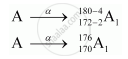
Formation of A2 by β decay:
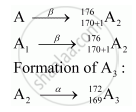
Formation of A4:

In r-decay, mass number and atomic number remain the same.

Thus,
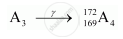
Mass number of A4 = 172

Atomic number of A4­ = 169

shaalaa.com
  क्या इस प्रश्न या उत्तर में कोई त्रुटि है?
2008-2009 (March) Delhi set 1

वीडियो ट्यूटोरियलVIEW ALL [1]

संबंधित प्रश्न

A source contains two phosphorous radio nuclides `""_15^32"P"` (T1/2 = 14.3d) and `""_15^33"P"` (T1/2 = 25.3d). Initially, 10% of the decays come from `""_15^33"P"`. How long one must wait until 90% do so?


(a) Derive the relation between the decay constant and half life of a radioactive substance. 
(b) A radioactive element reduces to 25% of its initial mass in 1000 years. Find its half life.


Why is it experimentally found difficult to detect neutrinos in this process ?


The decay constant of a radioactive sample is λ. The half-life and the average-life of the sample are respectively


28Th emits an alpha particle to reduce to 224Ra. Calculate the kinetic energy of the alpha particle emitted in the following decay:

`""^228"Th" → ""^224"Ra"^(∗) + alpha`

`""^224"Ra"^(∗) → ""^224"Ra" + γ (217 "keV")`.

Atomic mass of 228Th is 228.028726 u, that of 224Ra is 224.020196 u and that of  `""_2^4H` is 4.00260 u.

(Use Mass of proton mp = 1.007276 u, Mass of `""_1^1"H"` atom = 1.007825 u, Mass of neutron mn = 1.008665 u, Mass of electron = 0.0005486 u ≈ 511 keV/c2,1 u = 931 MeV/c2.)


Calculate the maximum kinetic energy of the beta particle emitted in the following decay scheme:
12N → 12C* + e+ + v
12C* → 12C + γ (4.43MeV).
The atomic mass of 12N is 12.018613 u.

(Use Mass of proton mp = 1.007276 u, Mass of `""_1^1"H"` atom = 1.007825 u, Mass of neutron mn = 1.008665 u, Mass of electron = 0.0005486 u ≈ 511 keV/c2,1 u = 931 MeV/c2.)


Disintegration rate of a sample is 1010 per hour at 20 hours from the start. It reduces to 6.3 x 10⁹ per hour after 30 hours. Calculate its half-life and the initial number of radioactive atoms in the sample.


Obtain an expression for the decay law of radioactivity. Hence show that the activity A(t) =λNO e-λt.  


Two radioactive materials Y1 and Y2 have decay constants '5`lambda`' and `lambda` respectively. Initially they have same number of nuclei. After time 't', the ratio of number of nuclei of Y1 to that of Y2 is `1/"e"`, then 't' is equal to ______.


Which sample, A or B shown in figure has shorter mean-life?


Share
Notifications

Englishहिंदीमराठी


      Forgot password?
Use app×