Advertisements
Advertisements
प्रश्न
A thin conducting spherical shell of radius R has charge Q spread uniformly over its surface. Using Gauss’s law, derive an expression for an electric field at a point outside the shell.
Advertisements
उत्तर
According to Gauss law,
`epsi_0EointdA=q`
Where,
q is the point charge
E is electric field due to the point charge
dA is a small area on the Gaussian surface at any distance and
`epsi_0` is the proportionality constant
For a spherical shell at distance r from the point charge, the integral `ointdA` is merely the sum of all differential of dA on the sphere.
Therefore, `oint dA =4pir^2`
`epsi_0E(4pir^2) = q`
or `,E = q/(epsi4pir^2)`
Therefore, for a thin conducting spherical shell of radius R and charge Q, spread uniformly over its surface, the electric field at any point outside the shell is
`E = Q/(e_0 4pir^2)`
Where r is the distance of the point from the centre of the shell.
`E = q/(4piepsi_0r^2)`
APPEARS IN
संबंधित प्रश्न
Answer the following question.
State Gauss's law for magnetism. Explain its significance.
Gaussian surface cannot pass through discrete charge because ____________.
The Electric flux through the surface
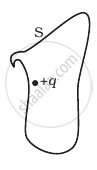 (i) |
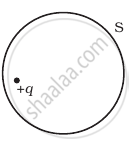 (ii) |
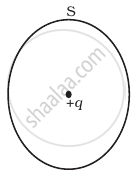 (iii) |
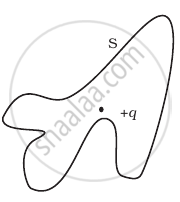 (iv) |
Refer to the arrangement of charges in figure and a Gaussian surface of radius R with Q at the centre. Then

- total flux through the surface of the sphere is `(-Q)/ε_0`.
- field on the surface of the sphere is `(-Q)/(4 piε_0 R^2)`.
- flux through the surface of sphere due to 5Q is zero.
- field on the surface of sphere due to –2Q is same everywhere.
If the total charge enclosed by a surface is zero, does it imply that the elecric field everywhere on the surface is zero? Conversely, if the electric field everywhere on a surface is zero, does it imply that net charge inside is zero.
The region between two concentric spheres of radii a < b contain volume charge density ρ(r) = `"c"/"r"`, where c is constant and r is radial- distanct from centre no figure needed. A point charge q is placed at the origin, r = 0. Value of c is in such a way for which the electric field in the region between the spheres is constant (i.e. independent of r). Find the value of c:
For a Gaussian surface to be convenient for calculations, the electric field should be:
According to Gauss's Law, the total electric flux through a closed surface depends on:
For an infinite line charge with linear charge density λ, which Gaussian surface is most appropriate?
Gauss's Law is equivalent to:
