Advertisements
Advertisements
प्रश्न
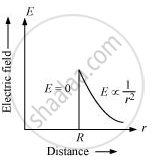
Draw a graph of electric field E(r) with distance r from the centre of the shell for 0 ≤ r ≤ ∞.
Advertisements
उत्तर
The graph of electric field E(r) with distance r from the centre of the shell for 0 ≤ r ≤ ∞.
APPEARS IN
संबंधित प्रश्न
Answer the following question.
State Gauss's law for magnetism. Explain its significance.
q1, q2, q3 and q4 are point charges located at points as shown in the figure and S is a spherical gaussian surface of radius R. Which of the following is true according to the Gauss' law?

The surface considered for Gauss’s law is called ______.
Five charges q1, q2, q3, q4, and q5 are fixed at their positions as shown in figure. S is a Gaussian surface. The Gauss’s law is given by `oint_s E.ds = q/ε_0`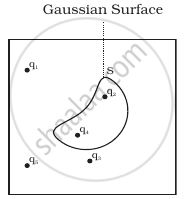
Which of the following statements is correct?
In finding the electric field using Gauss law the formula `|vec"E"| = "q"_"enc"/(epsilon_0|"A"|)` is applicable. In the formula ε0 is permittivity of free space, A is the area of Gaussian surface and qenc is charge enclosed by the Gaussian surface. This equation can be used in which of the following situation?
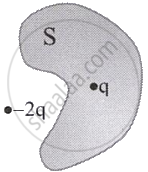
In the diagram, the total electric flux through the closed surface ‘S’ is:
[Given q = charge ε0 = permittivity of free space]
A Gaussian surface is best described as:
According to Gauss's Law, the total electric flux through a closed surface depends on:
The integral form of Gauss's Law is given by:
