Advertisements
Advertisements
प्रश्न
Answer the following question.
State Gauss's law for magnetism. Explain its significance.
Advertisements
उत्तर
The net magnetic flux (ΦB) through any closed surface is always zero.
This law suggests that the number of magnetic field lines leaving any closed surface is always equal to the number of magnetic field lines entering it.
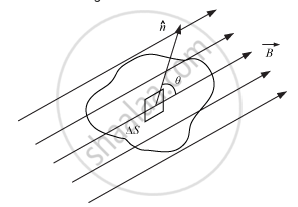
Suppose a closed surface S is held in a uniform magnetic field `vecB`.
Consider a small vector area element Δ`vec"S"` of this surface.
Magnetic flux through this area element is defined as ΔΦB = `vec"B".Δvec"S" `
Considering all small area elements of the surface, we obtain net magnetic flux through the surface as:
ØB = `sum_"All" ΔØ_"B" = sum_"All" vec"B". Δvec"S" = 0`
APPEARS IN
संबंधित प्रश्न
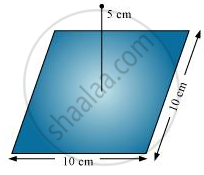
A point charge +10 μC is a distance 5 cm directly above the centre of a square of side 10 cm, as shown in the Figure. What is the magnitude of the electric flux through the square? (Hint: Think of the square as one face of a cube with edge 10 cm.)
A charge Q is placed at the centre of a cube. Find the flux of the electric field through the six surfaces of the cube.
Gauss' law helps in ______
If there were only one type of charge in the universe, then ______.
- `oint_s` E.dS ≠ 0 on any surface.
- `oint_s` E.dS = 0 if the charge is outside the surface.
- `oint_s` E.dS could not be defined.
- `oint_s` E.dS = `q/ε_0` if charges of magnitude q were inside the surface.
According to Gauss's Law, the total electric flux through a closed surface depends on:
What is the SI unit of permittivity of free space (ε₀)?
For an infinite line charge with linear charge density λ, which Gaussian surface is most appropriate?
Gauss's Law is equivalent to:
In a non-uniform electric field given by \[\vec{E} = \alpha x^{1/2} \hat{i}\] with \[\alpha = 800 \text{ N C}^{-1}\text{m}^{-1/2}\], the flux through a cube of side a = 0.1 m oriented with faces perpendicular to the x-axis is approximately:
