Advertisements
Advertisements
Question
Answer the following question.
State Gauss's law for magnetism. Explain its significance.
Advertisements
Solution
The net magnetic flux (ΦB) through any closed surface is always zero.
This law suggests that the number of magnetic field lines leaving any closed surface is always equal to the number of magnetic field lines entering it.
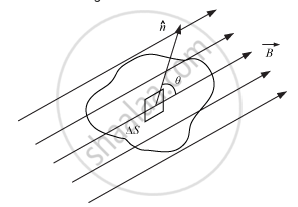
Suppose a closed surface S is held in a uniform magnetic field `vecB`.
Consider a small vector area element Δ`vec"S"` of this surface.
Magnetic flux through this area element is defined as ΔΦB = `vec"B".Δvec"S" `
Considering all small area elements of the surface, we obtain net magnetic flux through the surface as:
ØB = `sum_"All" ΔØ_"B" = sum_"All" vec"B". Δvec"S" = 0`
APPEARS IN
RELATED QUESTIONS
State and explain Gauss’s law.
A charge ‘q’ is placed at the centre of a cube of side l. What is the electric flux passing through each face of the cube?
State Gauss's law in electrostatics. Show, with the help of a suitable example along with the figure, that the outward flux due to a point charge 'q'. in vacuum within a closed surface, is independent of its size or shape and is given by `q/ε_0`
Consider a region inside which there are various types of charges but the total charge is zero. At points outside the region
- the electric field is necessarily zero.
- the electric field is due to the dipole moment of the charge distribution only.
- the dominant electric field is `∞ 1/r^3`, for large r, where r is the distance from a origin in this region.
- the work done to move a charged particle along a closed path, away from the region, will be zero.
An arbitrary surface encloses a dipole. What is the electric flux through this surface?
If the total charge enclosed by a surface is zero, does it imply that the elecric field everywhere on the surface is zero? Conversely, if the electric field everywhere on a surface is zero, does it imply that net charge inside is zero.
A charge Q is placed at the centre of a cube. The electric flux through one of its faces is ______.
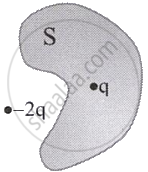
In the diagram, the total electric flux through the closed surface ‘S’ is:
[Given q = charge ε0 = permittivity of free space]
A charge of +5 μC is placed at the centre of two concentric spheres of radii r1 = 3 cm and r2 = 5 cm. The ratio of the flux through sphere of radius r1 to that through sphere of radius r2 will be ______.
