Advertisements
Advertisements
Question
A charge Q is placed at the centre of a cube. The electric flux through one of its faces is ______.
Options
`Q/epsi_0`
`Q/(6epsi_0)`
`Q/(8epsi_0)`
`Q/(3epsi_0)`
Advertisements
Solution
A charge Q is placed at the centre of a cube. The electric flux through one of its faces is `underlinebb(Q/(6epsi_0))`.
Explanation:
Assuming the cube as a Gaussian surface, the total flux passing through the cube of side l can be given as,
`phi = Q/epsi_0`
Flux through each face of the cube: As the charge is placed symmetrically to each face of the cube, thus electric flux passing through each face is equal.
∴ Electric flux passing through each face,
`phi^' = phi/6 = Q/(6epsi_0)`
APPEARS IN
RELATED QUESTIONS
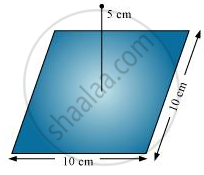
A point charge +10 μC is a distance 5 cm directly above the centre of a square of side 10 cm, as shown in the Figure. What is the magnitude of the electric flux through the square? (Hint: Think of the square as one face of a cube with edge 10 cm.)
q1, q2, q3 and q4 are point charges located at points as shown in the figure and S is a spherical gaussian surface of radius R. Which of the following is true according to the Gauss' law?

The Gaussian surface ______.
Five charges q1, q2, q3, q4, and q5 are fixed at their positions as shown in figure. S is a Gaussian surface. The Gauss’s law is given by `oint_s E.ds = q/ε_0`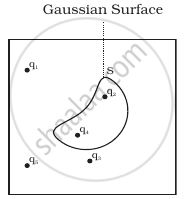
Which of the following statements is correct?
According to Gauss's Law, the total electric flux through a closed surface depends on:
In the context of Gauss's Law, what does the area element vector dS represent?
For an infinite line charge with linear charge density λ, which Gaussian surface is most appropriate?
For a uniformly charged thin spherical shell, what is the electric field at any point inside the shell (r < R)?
