Advertisements
Advertisements
प्रश्न
State and explain Gauss’s law.
Advertisements
उत्तर
Gauss’s law states that the flux of the electric field through any closed surface S is 1/∈ₒ times the total charge enclosed by S
Let the total flux through a sphere of radius r enclose a point charge q at its centre. Divide the sphere into a small area element as shown in the figure.
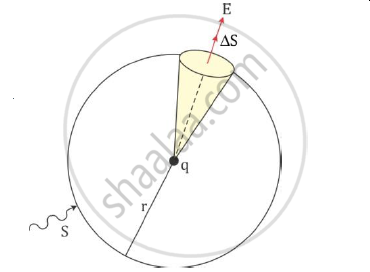
The flux through an area element ΔS is
`Deltaphi=E.DeltaS=q/(4piin_0r^2)hatr.DeltaS`
Here, we have used Coulomb’s law for the electric field due to a single charge q.
The unit vector `hatr`is along the radius vector from the centre to the area element. Because the normal to a sphere at every point is along the radius vector at that point, the area element ΔS and `hatr` have the same direction. Therefore
`Deltaphi=q/(4piin_0r^2)DeltaS`
Because the magnitude of the unit vector is 1, the total flux through the sphere is obtained by adding the flux through all the different area elements.
`phi=sum_(all DeltaS)q/(4piin_0r^2)DeltaS`
Because each area element of the sphere is at the same distance r from the charge,
`phi=q/(4piin_0r^2)sum_(all DeltaS)DeltaS=q/(4piin_0r^2)S`
Now, S the total area of the sphere equals 4πr². Thus,
`pi=q/(4piin_0r^2)xx4pir^2=q/in_0`
Hence, the above equation is a simple illustration of a general result of electrostatics called Gauss’s law
APPEARS IN
संबंधित प्रश्न
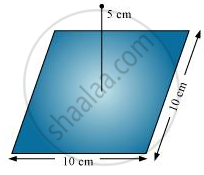
A point charge +10 μC is a distance 5 cm directly above the centre of a square of side 10 cm, as shown in the Figure. What is the magnitude of the electric flux through the square? (Hint: Think of the square as one face of a cube with edge 10 cm.)
A charge ‘q’ is placed at the centre of a cube of side l. What is the electric flux passing through each face of the cube?
Answer the following question.
State Gauss's law for magnetism. Explain its significance.
The surface considered for Gauss’s law is called ______.
In 1959 Lyttleton and Bondi suggested that the expansion of the Universe could be explained if matter carried a net charge. Suppose that the Universe is made up of hydrogen atoms with a number density N, which is maintained a constant. Let the charge on the proton be: ep = – (1 + y)e where e is the electronic charge.
- Find the critical value of y such that expansion may start.
- Show that the velocity of expansion is proportional to the distance from the centre.
According to Gauss's Law, the total electric flux through a closed surface depends on:
Gauss's Law is equivalent to:
In a non-uniform electric field given by \[\vec{E} = \alpha x^{1/2} \hat{i}\] with \[\alpha = 800 \text{ N C}^{-1}\text{m}^{-1/2}\], the flux through a cube of side a = 0.1 m oriented with faces perpendicular to the x-axis is approximately:
For the cylinder in the piecewise-uniform field, the charge enclosed is:
