Advertisements
Advertisements
प्रश्न
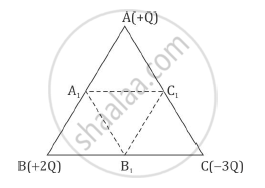
Three point charges, + Q + 2Q and – 3Q are placed at the vertices of an equilateral triangle ABC of side l. If these charges are displaced to the mid-point A1, B1 and C1, respectively, find the amount of the work done in shifting the charges to the new locations.
Advertisements
उत्तर
q1= +Q
q2= +2Q
q3= -3Q
r = l (for each side)
Intial potential energy of system
`U_1=1/(4piin_0l)[(q_1xxq_2)+(q_2xxq_3)+(q_3xxq_1)]`
`U_1=1/(4piin_0l)[(Qxx2Q)+(2Qxx(-3Q))+((-3Q) xxQ)]`
`U_1=(-7Q^2)/(4piin_0l`
These charges displaced to mid points then final potential energy of system,
`U_2=1/(4piin_0l/2)[(q_1xxq_2)+(q_2xxq_3)+(q_3xxq_1)]`
`U_2=2/(4piin_0l)[(Qxx2Q)+(2Qxx(-3Q))+((-3Q)xxQ)]`
`U_2=(-7Q^2)/(2piin_0l)`
Work done, W = U2 - U1
`W=(-7Q^2)/(2piin_0l)-(-7Q^2)/(4piin_0l)`
`W=(7Q^2)/(piin_0l)[(-1)/2-((-1)/4)]=(7Q^2)/(piin_0l)[(-1)/2+1/4]`
`W=(-7)/4(Q^2/(piin_0l))`
संबंधित प्रश्न
We know that electric field is discontinuous across the surface of a charged conductor. Is electric potential also discontinuous there?
Guess a possible reason why water has a much greater dielectric constant (= 80) than say, mica (= 6).
Why must electrostatic field be normal to the surface at every point of a charged conductor?
The electrostatic potential energy of two-point charges, 1 µC each, placed 1 meter apart in the air is:
A body moves from point A to B under the action of a force, varying in magnitude as shown in the figure. Force is expressed in newton and displacement in meter. What is the total work done?

If stretch in a spring of force constant k is tripled then the ratio of elastic potential energy in the two cases will be:
A work of 100 joule is performed in carrying a charge of 5 coulomb form infinity to a particular. point in an' electrostatic field. The potential of this point is:-
Potential energy of two equal negative point charges 2µc each held lm apart in air is:-
When one electron is taken towards the other electron, then the electric potential energy of the system ______
A point charge q0 is moving along a circular path of radius a, with a point charge Q at the centre of the circle. The kinetic energy of q0 is ______.
