Advertisements
Advertisements
प्रश्न
Define electric flux.
Define electric flux. Is it a scalar or a vector quantity?
Advertisements
उत्तर १
Electric flux is the total number of lines of force passing through the unit area of a surface held perpendicularly.
Electric flux ΔΦ through an area element ΔS is given by
ΔΦ = E.ΔS = EΔScosθ
θ is the angle between E and ΔS.
उत्तर २
Electric flux is defined as the number of electric field lines crossing the per unit area. It is given as
`triangle phi = vecE.vec(triangleS) cos theta`
where `vecE` is Electric field and `vec(triangleS)`is area vector. The angle θ here is the angle between `vecE` and `vec(triangle S)`.
Since Electric flux is the dot product of two vectors, Hence it is a Scalar quantity.
APPEARS IN
संबंधित प्रश्न
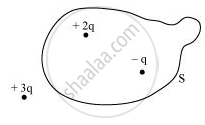
Figure shows three point charges +2q, −q and + 3q. Two charges + 2q and −q are enclosed within a surface ‘S’. What is the electric flux due to this configuration through the surface ‘S’?
A charge 'Q' µC is placed at the centre of a cube. The flux through one face and two opposite faces of the cube is respectively ______.
The electric field in a region is given by `bar"E" = 4hat"i" + 10hat"j"` N/C. The flux of this field through a square of 10 cm on a side whose plane is parallel to the XZ plane.
If the electric flux entering and leaving an enclosed surface respectively is Φ1 and Φ2, the electric charge inside the surface will be
The S.I. unit of electric flux is ______
A hollow sphere of radius R has a point charge q at its centre. Electric flux emanating from the sphere is X. How will the electric flux change, if at all, when charge q is replaced by an electric dipole?
The formula for electric flux when the electric field is uniform is expressed as which of the following?
When the electric field is parallel to the surface, what is the angle θ between the field vector and the area vector?
