Advertisements
Advertisements
प्रश्न
A uniformly charged conducting sphere of 2.4 m diameter has a surface charge density of 80.0 μC/m2.
- Find the charge on the sphere.
- What is the total electric flux leaving the surface of the sphere?
Advertisements
उत्तर
Given: d = 2.4 m
R = `2.4/2` m = 1.2 m
σ = 80.0 μC/m2
= 80 × 10−6 C/m2
(a) As σ = `q/(4pir^2)`
so, q = 4πr2 × σ
= 4 × 3.14 × (1.2)2 × 80 ×10−6
= 1446.9 ×10−6
or q = 1.45 × 10⁻³ C
(b) Φ = `q/ε_0`
= `(1.45 xx 10^-3)/(8.85 xx 10^-12)`
= 0.1638 × 109
= 1.64 × 10⁸ N C−1 m2
संबंधित प्रश्न
Given a uniform electric field \[\vec{E} = 2 \times {10}^3 \ \hat{i}\] N/C, find the flux of this field through a square of side 20 cm, whose plane is parallel to the y−z plane. What would be the flux through the same square, if the plane makes an angle of 30° with the x−axis ?
Given a uniform electric filed \[\vec{E} = 4 \times {10}^3 \ \hat{i} N/C\]. Find the flux of this field through a square of 5 cm on a side whose plane is parallel to the Y-Z plane. What would be the flux through the same square if the plane makes a 30° angle with the x-axis?
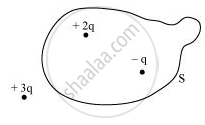
Figure shows three point charges +2q, −q and + 3q. Two charges + 2q and −q are enclosed within a surface ‘S’. What is the electric flux due to this configuration through the surface ‘S’?
Electric charges are distributed in a small volume. The flux of the electric field through a spherical surface of radius 10 cm surrounding the total charge is 25 V m. The flux over a concentric sphere of radius 20 cm will be _____________ .
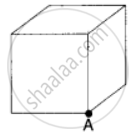
The total flux through the faces of the cube with side of length a if a charge q is placed at corner A of the cube is ______.
Total electric flux coming out of a unit positive charge kept in air is ______.
A charge Qµc is placed at the centre of a cube the flux coming from any surface will be.
The S.I. unit of electric flux is ______
A circular disc of radius 'r' is placed along the plane of paper. A uniform electric field `vec"E"` is also present in the plane of paper. What amount of electric flux is associated with it?

The electric charges are distributed in a small volume. The flux of the electric field through a spherical surface of radius 10 cm surrounding the total charge is 20 V-m. The flux over a concentric sphere of radius 20 cm will be ______.
A hollow sphere of radius R has a point charge q at its centre. Electric flux emanating from the sphere is X. How will the electric flux change, if at all, when charge q is replaced by an electric dipole?
An electric field is given by `(6 hat i + 5 hat j + 3 hat k)` N/C. The electric flux through a surface area `30 hat i` m2 lying in YZ-plane (in SI unit) is ______.
For a general surface, electric flux is calculated using which integral expression?
In the electric flux formula \[\Phi = EA \cos \theta\], what does θ represent?
According to the rain analogy for electric flux, what determines how much rain (field) passes through a tilted sheet of cardboard?
For an open surface, which statement correctly describes the area vector convention?
When the electric field direction is opposite to the area vector (θ = 180°), what is the flux?
