Advertisements
Advertisements
प्रश्न
An infinite line charge produces a field of 9 × 10⁴ N/C at a distance of 2 cm. Calculate the linear charge density.
Advertisements
उत्तर
Given: E = 9 × 10⁴
ε0 = 8.85 × 10⁻¹² C2 N−1 m−2
r = 2 cm = 0.02 m
Formula: `E = lambda/(2piε_0 r)`
λ = E (2πε0r)
= 9 × 104 × 2 × 3.14 × 8.85 × 10−12 × 0.02
= 10.0 × 10−8
= 1 × 10⁻⁷ C m−1
= 0.1 μC m−1
Therefore, the linear charge density is 0.1 μC m−1.
APPEARS IN
संबंधित प्रश्न
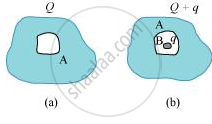
(a) A conductor A with a cavity as shown in Fig (a) is given a charge Q. Show that the entire charge must appear on the outer surface of the conductor.
(b) Another conductor B with charge q is inserted into the cavity keeping B insulated from A. Show that the total charge on the outside surface of A is Q + q [Fig. (b)].
(c) A sensitive instrument is to be shielded from the strong electrostatic fields in its environment. Suggest a possible way.
The number of electrons in an insulator is of the same order as the number of electrons in a conductor. What is then the basic difference between a conductor and an insulator ?
Answer the following question.
State the units of linear charge density.
Two charges 5 μC and -4μC are kept 5.0 m apart at points A and B respectively. How much work will have to be done to move the charge at A through a distance of 5.0 m further away from point B along the line BA?
In a region where intensity of electric field is 5 NC-1, 40 lines of electric force are crossing per square metre. The number of lines crossing per square metre where intensity of electric field is 10 NC-1 will be ______
Two large, thin metal plates are parallel and close to each other. On their inner faces, the plates have surface charge densities of opposite signs and of magnitude 17.7 × 10⁻²² C/m2. What is electric field intensity E:
- in the outer region of the first plate, and
- between the plates?
At the atomic level, charge exists in discrete units. What is the fundamental charge unit called, and what is its value?
Under what condition is a charge distribution treated as continuous rather than discrete?
Which of the following best defines linear charge density?
What is the SI unit of surface charge density?
For a surface charge distribution, if the surface charge density is σ and a small surface element has area dS, what is the charge element dq?
Which type of charge distribution is represented as two-dimensional (2D)?
The electric field due to a continuous charge distribution is derived by extending which fundamental principle?
For a surface charge distribution, what is the integral form of the electric field?
For a uniform charge distribution, what is the mathematical representation of charge density?
