Advertisements
Advertisements
प्रश्न
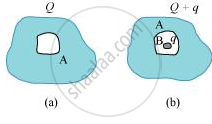
(a) A conductor A with a cavity as shown in Fig (a) is given a charge Q. Show that the entire charge must appear on the outer surface of the conductor.
(b) Another conductor B with charge q is inserted into the cavity keeping B insulated from A. Show that the total charge on the outside surface of A is Q + q [Fig. (b)].
(c) A sensitive instrument is to be shielded from the strong electrostatic fields in its environment. Suggest a possible way.
Advertisements
उत्तर
(a) Let us consider a Gaussian surface that is lying wholly within a conductor and enclosing the cavity. The electric field intensity E inside the charged conductor is zero.
Let q is the charge inside the conductor and `in_0` is the permittivity of free space.
According to Gauss’s law,
Flux, `phi = vec"E".vec("ds") = "q"/in_0`
Here, E = 0
`"q"/in_0 = 0`
∵ ∈0 `≠` 0
∴ q = 0
Therefore, charge inside the conductor is zero.
The entire charge Q appears on the outer surface of the conductor.
(b) The outer surface of conductor A has a charge of amount Q. Another conductor B having charge +q is kept inside conductor A and it is insulated from A. Hence, a charge of amount −q will be induced in the inner surface of conductor A and +q is induced on the outer surface of conductor A. Therefore, the total charge on the outer surface of conductor A is Q + q.
(c) A sensitive instrument can be shielded from the strong electrostatic field in its environment by enclosing it fully inside a metallic surface. A closed metallic body acts as an electrostatic shield.
APPEARS IN
संबंधित प्रश्न
A hollow charged conductor has a tiny hole cut into its surface. Show that the electric field in the hole is `(sigma/(2in_0)) hat"n"`. where `hat"n"` is the unit vector in the outward normal direction, and `sigma` is the surface charge density near the hole.
Answer the following question.
State the units of linear charge density.
In a region where intensity of electric field is 5 NC-1, 40 lines of electric force are crossing per square metre. The number of lines crossing per square metre where intensity of electric field is 10 NC-1 will be ______
Which of the following is three-dimensional continuous charge distribution?
There is a uniform spherically symmetric surface charge density at a distance Ro from the origin. The charge distribution is initially at rest and starts expanding because of mutual repulsion. The figure that represents best the speed V (R(t)) of the distribution as a function of its instantaneous radius R(t) is:
An infinite line charge produces a field of 9 × 10⁴ N/C at a distance of 2 cm. Calculate the linear charge density.
At the atomic level, charge exists in discrete units. What is the fundamental charge unit called, and what is its value?
Under what condition is a charge distribution treated as continuous rather than discrete?
Which of the following best defines linear charge density?
What is the SI unit of volume charge density?
For a volume charge distribution, if the volume charge density is ρ and a small volume element is dV, what is the charge element dq?
Which type of charge distribution is represented as one-dimensional (1D)?
Which type of charge distribution is represented as three-dimensional (3D)?
The electric field due to a continuous charge distribution is derived by extending which fundamental principle?
For a volume charge distribution, what is the integral form of the electric field?
What is the defining characteristic of a uniform charge distribution?
For a uniform charge distribution, what is the mathematical representation of charge density?
