Advertisements
Advertisements
Question
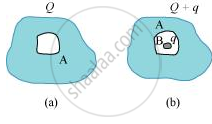
(a) A conductor A with a cavity as shown in Fig (a) is given a charge Q. Show that the entire charge must appear on the outer surface of the conductor.
(b) Another conductor B with charge q is inserted into the cavity keeping B insulated from A. Show that the total charge on the outside surface of A is Q + q [Fig. (b)].
(c) A sensitive instrument is to be shielded from the strong electrostatic fields in its environment. Suggest a possible way.
Advertisements
Solution
(a) Let us consider a Gaussian surface that is lying wholly within a conductor and enclosing the cavity. The electric field intensity E inside the charged conductor is zero.
Let q is the charge inside the conductor and `in_0` is the permittivity of free space.
According to Gauss’s law,
Flux, `phi = vec"E".vec("ds") = "q"/in_0`
Here, E = 0
`"q"/in_0 = 0`
∵ ∈0 `≠` 0
∴ q = 0
Therefore, charge inside the conductor is zero.
The entire charge Q appears on the outer surface of the conductor.
(b) The outer surface of conductor A has a charge of amount Q. Another conductor B having charge +q is kept inside conductor A and it is insulated from A. Hence, a charge of amount −q will be induced in the inner surface of conductor A and +q is induced on the outer surface of conductor A. Therefore, the total charge on the outer surface of conductor A is Q + q.
(c) A sensitive instrument can be shielded from the strong electrostatic field in its environment by enclosing it fully inside a metallic surface. A closed metallic body acts as an electrostatic shield.
APPEARS IN
RELATED QUESTIONS
Infinite charges of magnitude q each are lying at x = 1, 2, 4, 8 ... metre on X-axis. The value of the intensity of the electric field at point x = 0 due to these charges will be ______
Which of the following is three-dimensional continuous charge distribution?
Two large, thin metal plates are parallel and close to each other. On their inner faces, the plates have surface charge densities of opposite signs and of magnitude 17.7 × 10⁻²² C/m2. What is electric field intensity E:
- in the outer region of the first plate, and
- between the plates?
There is a uniform spherically symmetric surface charge density at a distance Ro from the origin. The charge distribution is initially at rest and starts expanding because of mutual repulsion. The figure that represents best the speed V (R(t)) of the distribution as a function of its instantaneous radius R(t) is:
An infinite line charge produces a field of 9 × 10⁴ N/C at a distance of 2 cm. Calculate the linear charge density.
Which of the following best defines linear charge density?
What is the SI unit of surface charge density?
For a linear charge distribution, if the linear charge density is λ and a small element has length dl, what is the charge element dq?
For a volume charge distribution, if the volume charge density is ρ and a small volume element is dV, what is the charge element dq?
Which type of charge distribution is represented as one-dimensional (1D)?
Which type of charge distribution is represented as two-dimensional (2D)?
Which type of charge distribution is represented as three-dimensional (3D)?
The electric field due to a continuous charge distribution is derived by extending which fundamental principle?
For a volume charge distribution, what is the integral form of the electric field?
For a uniform charge distribution, what is the mathematical representation of charge density?
What is the defining characteristic of a non-uniform charge distribution?
For a non-uniform charge distribution, how is charge density mathematically represented?
