Advertisements
Advertisements
प्रश्न
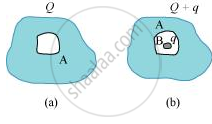
(a) A conductor A with a cavity as shown in Fig (a) is given a charge Q. Show that the entire charge must appear on the outer surface of the conductor.
(b) Another conductor B with charge q is inserted into the cavity keeping B insulated from A. Show that the total charge on the outside surface of A is Q + q [Fig. (b)].
(c) A sensitive instrument is to be shielded from the strong electrostatic fields in its environment. Suggest a possible way.
Advertisements
उत्तर
(a) Let us consider a Gaussian surface that is lying wholly within a conductor and enclosing the cavity. The electric field intensity E inside the charged conductor is zero.
Let q is the charge inside the conductor and `in_0` is the permittivity of free space.
According to Gauss’s law,
Flux, `phi = vec"E".vec("ds") = "q"/in_0`
Here, E = 0
`"q"/in_0 = 0`
∵ ∈0 `≠` 0
∴ q = 0
Therefore, charge inside the conductor is zero.
The entire charge Q appears on the outer surface of the conductor.
(b) The outer surface of conductor A has a charge of amount Q. Another conductor B having charge +q is kept inside conductor A and it is insulated from A. Hence, a charge of amount −q will be induced in the inner surface of conductor A and +q is induced on the outer surface of conductor A. Therefore, the total charge on the outer surface of conductor A is Q + q.
(c) A sensitive instrument can be shielded from the strong electrostatic field in its environment by enclosing it fully inside a metallic surface. A closed metallic body acts as an electrostatic shield.
APPEARS IN
संबंधित प्रश्न
A hollow charged conductor has a tiny hole cut into its surface. Show that the electric field in the hole is `(sigma/(2in_0)) hat"n"`. where `hat"n"` is the unit vector in the outward normal direction, and `sigma` is the surface charge density near the hole.
Answer the following question.
State the units of linear charge density.
In a region where intensity of electric field is 5 NC-1, 40 lines of electric force are crossing per square metre. The number of lines crossing per square metre where intensity of electric field is 10 NC-1 will be ______
An infinite line charge produces a field of 9 × 10⁴ N/C at a distance of 2 cm. Calculate the linear charge density.
At the atomic level, charge exists in discrete units. What is the fundamental charge unit called, and what is its value?
Under what condition is a charge distribution treated as continuous rather than discrete?
Which of the following best defines linear charge density?
What is the SI unit of surface charge density?
What is the SI unit of volume charge density?
For a linear charge distribution, if the linear charge density is λ and a small element has length dl, what is the charge element dq?
For a surface charge distribution, if the surface charge density is σ and a small surface element has area dS, what is the charge element dq?
Which type of charge distribution is represented as one-dimensional (1D)?
Which type of charge distribution is represented as two-dimensional (2D)?
Which type of charge distribution is represented as three-dimensional (3D)?
A metal plate is an example of which type of charge distribution?
The electric field due to a continuous charge distribution is derived by extending which fundamental principle?
For a linear charge distribution, what is the integral form of the electric field?
For a non-uniform charge distribution, how is charge density mathematically represented?
