Advertisements
Advertisements
प्रश्न
Given a uniform electric field \[\vec{E} = 2 \times {10}^3 \ \hat{i}\] N/C, find the flux of this field through a square of side 20 cm, whose plane is parallel to the y−z plane. What would be the flux through the same square, if the plane makes an angle of 30° with the x−axis ?
Advertisements
उत्तर
When the plane is parallel to the y-z plane:
\[\phi = \vec{E .} A^\rightharpoonup \]
\[Here: \]
\[ \vec{E} = 2 \times {10}^3 \ \hat{i} N/C\]
\[ A^\rightharpoonup = \left( 20 cm \right)^2 \hat{i} = 4 \times {10}^{- 2} \ \hat{i} m^2 \]
\[ \therefore \phi = \left( 2 \times {10}^3 \ \hat{i} \right) . \left( 4 \times {10}^{- 2} \ \hat{i} \right)\]
\[ \Rightarrow \phi = 80 \ \text { Weber }\]
When the plane makes a 30° angle with the x-axis, the area vector makes a 60° angle with the x-axis.
\[\phi = \vec{E .} A^\rightharpoonup \]
\[ \Rightarrow \phi = EA \cos\theta\]
\[ \Rightarrow \phi = \left( 2 \times {10}^3 \right)\left( 4 \times {10}^{- 2} \right)\cos60°\]
\[ \Rightarrow \phi = \frac{80}{2}\]
\[ \Rightarrow \phi = 40 \text { Weber}\]
APPEARS IN
संबंधित प्रश्न
Define electric flux.
"The outward electric flux due to charge +Q is independent of the shape and size of the surface which encloses is." Give two reasons to justify this statement.
Consider a uniform electric field E = 3 × 10³ `hat i` N/C.
- What is the flux of this field through a square of 10 cm on a side whose plane is parallel to the yz plane?
- What is the flux through the same square if the normal to its plane makes a 60° angle with the x-axis?
If the flux of the electric field through a closed surface is zero,
(a) the electric field must be zero everywhere on the surface
(b) the electric field may be zero everywhere on the surface
(c) the charge inside the surface must be zero
(d) the charge in the vicinity of the surface must be zero
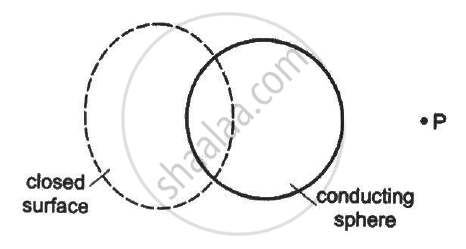
The following figure shows a closed surface that intersects a conducting sphere. If a positive charge is placed at point P, the flux of the electric field through the closed surface
The electric flux through a closed Gaussian surface depends upon ______.
The S.I. unit of electric flux is ______
An electric field is given by `(6 hat i + 5 hat j + 3 hat k)` N/C. The electric flux through a surface area `30 hat i` m2 lying in YZ-plane (in SI unit) is ______.
For a general surface, electric flux is calculated using which integral expression?
