Advertisements
Advertisements
Question
Given a uniform electric field \[\vec{E} = 2 \times {10}^3 \ \hat{i}\] N/C, find the flux of this field through a square of side 20 cm, whose plane is parallel to the y−z plane. What would be the flux through the same square, if the plane makes an angle of 30° with the x−axis ?
Advertisements
Solution
When the plane is parallel to the y-z plane:
\[\phi = \vec{E .} A^\rightharpoonup \]
\[Here: \]
\[ \vec{E} = 2 \times {10}^3 \ \hat{i} N/C\]
\[ A^\rightharpoonup = \left( 20 cm \right)^2 \hat{i} = 4 \times {10}^{- 2} \ \hat{i} m^2 \]
\[ \therefore \phi = \left( 2 \times {10}^3 \ \hat{i} \right) . \left( 4 \times {10}^{- 2} \ \hat{i} \right)\]
\[ \Rightarrow \phi = 80 \ \text { Weber }\]
When the plane makes a 30° angle with the x-axis, the area vector makes a 60° angle with the x-axis.
\[\phi = \vec{E .} A^\rightharpoonup \]
\[ \Rightarrow \phi = EA \cos\theta\]
\[ \Rightarrow \phi = \left( 2 \times {10}^3 \right)\left( 4 \times {10}^{- 2} \right)\cos60°\]
\[ \Rightarrow \phi = \frac{80}{2}\]
\[ \Rightarrow \phi = 40 \text { Weber}\]
APPEARS IN
RELATED QUESTIONS
A uniformly charged conducting sphere of 2.4 m diameter has a surface charge density of 80.0 μC/m2.
- Find the charge on the sphere.
- What is the total electric flux leaving the surface of the sphere?
Given a uniform electric filed \[\vec{E} = 4 \times {10}^3 \ \hat{i} N/C\]. Find the flux of this field through a square of 5 cm on a side whose plane is parallel to the Y-Z plane. What would be the flux through the same square if the plane makes a 30° angle with the x-axis?
Two charges of magnitudes +4Q and − Q are located at points (a, 0) and (− 3a, 0) respectively. What is the electric flux due to these charges through a sphere of radius ‘2a’ with its centre at the origin?
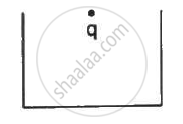
A charge q is placed at the centre of the open end of a cylindrical vessel (see the figure). The flux of the electric field through the surface of the vessel is ____________ .
The electric flux through a closed Gaussian surface depends upon ______.
A uniform electric field of intensity 400 N/C, exists in a certain region. How much flux will cross a given area of 10 cm2 in this region, if the area vector is inclined at 60° to the direction of the field?
A charge 'Q' µC is placed at the centre of a cube. The flux through one face and two opposite faces of the cube is respectively ______.
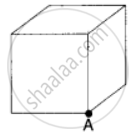
The total flux through the faces of the cube with side of length a if a charge q is placed at corner A of the cube is ______.
A charge Qµc is placed at the centre of a cube the flux coming from any surface will be.
What does positive electric flux indicate?
