Advertisements
Advertisements
Question
If the flux of the electric field through a closed surface is zero,
(a) the electric field must be zero everywhere on the surface
(b) the electric field may be zero everywhere on the surface
(c) the charge inside the surface must be zero
(d) the charge in the vicinity of the surface must be zero
Advertisements
Solution
(b) the electric field may be zero everywhere on the surface
(c) the charge inside the surface must be zero
As the flux is zero through the surface, the charge enclosed must be zero. But the electric field is not necessarily zero everywhere on the surface. For example, in the case of a dipole enclosed by the surface, the electric field through the surface is not zero but has some value. So, the correct answers are (b) and (c).
APPEARS IN
RELATED QUESTIONS
Given a uniform electric field `vecE=5xx10^3hati`N/C, find the flux of this field through a square of 10 cm on a side whose plane is parallel to the y-z plane. What would be the flux through the same square if the plane makes a 30° angle with the x-axis ?
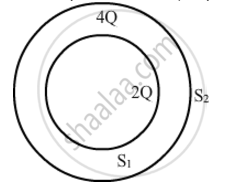
Consider two hollow concentric spheres, S1 and S2, enclosing charges 2Q and 4Q respectively as shown in the figure. (i) Find out the ratio of the electric flux through them. (ii) How will the electric flux through the sphere S1 change if a medium of dielectric constant 'εr' is introduced in the space inside S1 in place of air ? Deduce the necessary expression
Two charges of magnitudes −2Q and +Q are located at points (a, 0) and (4a, 0) respectively. What is the electric flux due to these charges through a sphere of radius ‘3a’ with its centre at the origin?
It is said that any charge given to a conductor comes to its surface. Should all the protons come to the surface? Should all the electrons come to the surface? Should all the free electrons come to the surface?
The electric field in a region is given by `vec"E"` = 5 `hatk`N/C. Calculate the electric flux Through a square of side 10.0 cm in the following cases
- The square is along the XY plane
- The square is along XZ plane
- The normal to the square makes an angle of 45° with the Z axis.
If the flux associated with a coil changes at the rate of 360 webers every 4 minutes, then the induced e.m.f. is ______
A charge 'Q' µC is placed at the centre of a cube. The flux through one face and two opposite faces of the cube is respectively ______.
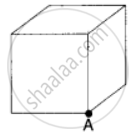
The total flux through the faces of the cube with side of length a if a charge q is placed at corner A of the cube is ______.
The SI unit of electric flux is ______.
The electric field intensity due to an infinite cylinder of radius R and having charge q per unit length at a distance rir r(r > R) from its axis is ______.
In a region of space having a uniform electric field E, a hemispherical bowl of radius r is placed. The electric flux Φ through the bowl is:
A charge Qµc is placed at the centre of a cube the flux coming from any surface will be.
An electric charge q is placed at the center of a cube of side ℓ. The electric flux on one of its faces will be ______.
A hollow sphere of radius R has a point charge q at its centre. Electric flux emanating from the sphere is X. How will the electric flux change, if at all, when charge q is replaced by an electric dipole?
In the electric flux formula \[\Phi = EA \cos \theta\], what does θ represent?
According to the rain analogy for electric flux, what determines how much rain (field) passes through a tilted sheet of cardboard?
What does positive electric flux indicate?
