Advertisements
Advertisements
Question
A thin straight infinitely long conducting wire having charge density λ is enclosed by a cylindrical surface of radius r and length l, its axis coinciding with the length of the wire. Find the expression for the electric flux through the surface of the cylinder.
Advertisements
Solution

The thin infinitely long straight line has a linear charge density λ.
Since the electric field for this kind of configuration will be radial and perpendicular to the wire, there will be no flux through the flat surfaces of the cylinder. Also, the electric field (E) will be constant at every point on the curved surface of the cylinder (as all points on it are equidistant from the wire) and perpendicular to it.
We shall us Gauss's law to find the electric flux through the cylinder. The charge enclosed by the cylinder is λ × l, as l is the length of the cylinder and it is also the length of the charged wire within the cylinder.
We know,
`\text { Electric flux} = (\text { Charge enclosed})/epsi_0 = (lambdal)/epsi_0`
APPEARS IN
RELATED QUESTIONS
Two charges of magnitudes +4Q and − Q are located at points (a, 0) and (− 3a, 0) respectively. What is the electric flux due to these charges through a sphere of radius ‘2a’ with its centre at the origin?
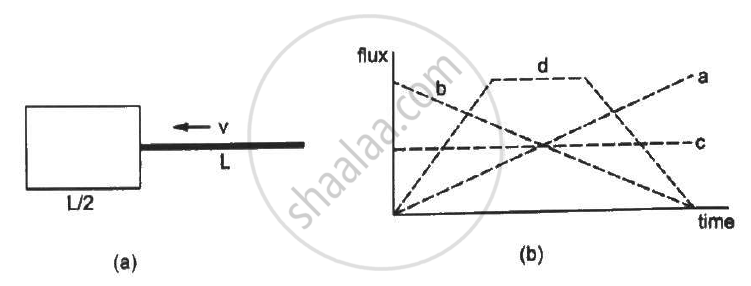
Following Figure (a) shows an imaginary cube of edge L/2. A uniformly charged rod of length (L) moves towards the left at a small but constant speed `nu.` At t = 0, the left end just touches the centre of the face of the cube opposite it. Which of the graphs shown in the figure (b) represents the flux of the electric field through the cube as the rod goes through it?
An electric charge q is placed at the centre of a cube of side a. The electric flux on one of its faces will be ______.
In a region of space having a uniform electric field E, a hemispherical bowl of radius r is placed. The electric flux Φ through the bowl is:
The electric charges are distributed in a small volume. The flux of the electric field through a spherical surface of radius 10 cm surrounding the total charge is 20 V-m. The flux over a concentric sphere of radius 20 cm will be ______.
A hollow cylinder has a charge of 'q' C within it. If 𝜙 is the electric flux associated with the curved surface B, the flux linked with the plane surface A will be ______.

For a general surface, electric flux is calculated using which integral expression?
