Advertisements
Advertisements
Question
Given a uniform electric filed \[\vec{E} = 4 \times {10}^3 \ \hat{i} N/C\]. Find the flux of this field through a square of 5 cm on a side whose plane is parallel to the Y-Z plane. What would be the flux through the same square if the plane makes a 30° angle with the x-axis?
Advertisements
Solution
When the plane is parallel to the y-z plane:
\[\text { Electric flux }, \phi = \vec{E .} A^\rightharpoonup \]
\[\text { Here }: \]
\[ \vec{E} = 4 \times {10}^3 \ \hat{i} N/C\]
\[ A^\rightharpoonup = \left( 5 cm \right)^2 \ \hat{i} = 0 . 25 \times {10}^{- 2} \ \hat{i} m^2 \]
\[ \therefore \phi = \left( 4 \times {10}^3 \ \hat{i} \right) . \left( 25 \times {10}^{- 4} \ \hat{i} \right)\]
\[ \Rightarrow \phi = 10 \text { Weber }\]
When the plane makes a 30° angle with x-axis, the area vector makes a 60° angle with the x-axis.
\[\phi = \vec{E .} \vec{A} \]
\[ \Rightarrow \phi = EA \cos\theta\]
\[ \Rightarrow \phi = \left( 4 \times {10}^3 \right)\left( 25 \times {10}^{- 4} \right)\cos60°\]
\[ \Rightarrow \phi = \frac{10}{2}\]
\[ \Rightarrow \phi = 5 \text { Weber }\]
APPEARS IN
RELATED QUESTIONS
How does the electric flux due to a point charge enclosed by a spherical Gaussian surface get affected when its radius is increased?
Write S.I unit of electric flux.
Given the electric field in the region `vecE=2xhati`, find the net electric flux through the cube and the charge enclosed by it.
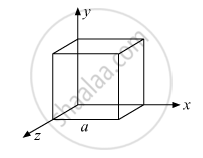
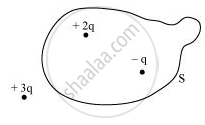
Figure shows three point charges +2q, −q and + 3q. Two charges + 2q and −q are enclosed within a surface ‘S’. What is the electric flux due to this configuration through the surface ‘S’?
Mark the correct options:
A hollow cylinder has a charge of 'q' C within it. If 𝜙 is the electric flux associated with the curved surface B, the flux linked with the plane surface A will be ______.

For a closed surface, which convention must be followed when assigning the area vector?
When the electric field is parallel to the surface, what is the angle θ between the field vector and the area vector?
What does negative electric flux indicate?
