Advertisements
Advertisements
Question
It is said that any charge given to a conductor comes to its surface. Should all the protons come to the surface? Should all the electrons come to the surface? Should all the free electrons come to the surface?
Advertisements
Solution
Protons never take part in any electrical phenomena because they are inside the nuclei and are not able to interact easily. These are the free electrons that are responsible for all electrical phenomena. So, if a conductor is given a negative charge, the free electrons come to the surface of the conductor. If the conductor is given a positive charge, electrons move away from the surface and leave a positive charge on the surface of the conductor.
APPEARS IN
RELATED QUESTIONS
Careful measurement of the electric field at the surface of a black box indicates that the net outward flux through the surface of the box is 8.0 × 10³ N m2/C.
- What is the net charge inside the box?
- If the net outward flux through the surface of the box were zero, could you conclude that there were no charges inside the box? Why or Why not?
Define Electric Flux.
Mark the correct options:
The electric flux through a closed Gaussian surface depends upon ______.
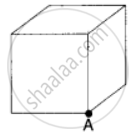
The total flux through the faces of the cube with side of length a if a charge q is placed at corner A of the cube is ______.
A cylinder of radius R and length L is placed in a uniform electric field E parallel to the cylinder axis. The total flux for the surface of the cylinder is given by ______.
If the electric flux entering and leaving an enclosed surface respectively is Φ1 and Φ2, the electric charge inside the surface will be
A circular disc of radius 'r' is placed along the plane of paper. A uniform electric field `vec"E"` is also present in the plane of paper. What amount of electric flux is associated with it?

A hollow sphere of radius R has a point charge q at its centre. Electric flux emanating from the sphere is X. How will the electric flux change, if at all, when radius of the sphere is doubled?
An electric field is given by `(6 hat i + 5 hat j + 3 hat k)` N/C. The electric flux through a surface area `30 hat i` m2 lying in YZ-plane (in SI unit) is ______.
The formula for electric flux when the electric field is uniform is expressed as which of the following?
In the electric flux formula \[\Phi = EA \cos \theta\], what does θ represent?
What is the SI unit of electric flux?
According to the rain analogy for electric flux, what determines how much rain (field) passes through a tilted sheet of cardboard?
When the surface is parallel to the electric field lines, what is the resulting electric flux?
When the electric field direction is opposite to the area vector (θ = 180°), what is the flux?
What does positive electric flux indicate?
