Advertisements
Advertisements
Question
Two charges of magnitudes +4Q and − Q are located at points (a, 0) and (− 3a, 0) respectively. What is the electric flux due to these charges through a sphere of radius ‘2a’ with its centre at the origin?
Advertisements
Solution
Gauss’ theorem states that the electric flux through a closed surface enclosing a charge is equal to `1/epsi_0`times the magnitude of the charge enclosed.
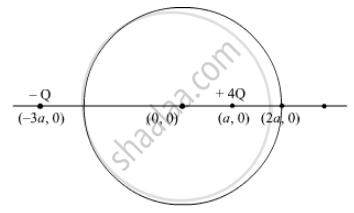
The sphere enclose charge = +4Q.
Thus,`phi = (4Q)/epsi_0`
APPEARS IN
RELATED QUESTIONS
Define electric flux.
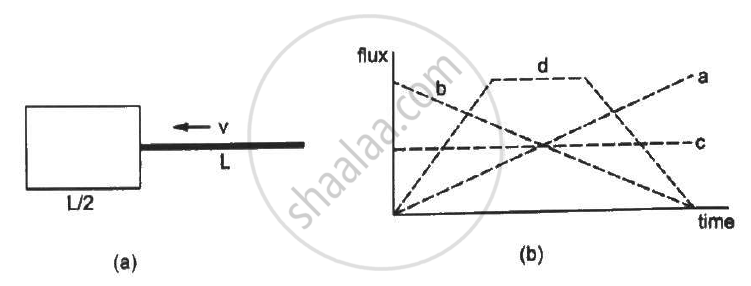
Following Figure (a) shows an imaginary cube of edge L/2. A uniformly charged rod of length (L) moves towards the left at a small but constant speed `nu.` At t = 0, the left end just touches the centre of the face of the cube opposite it. Which of the graphs shown in the figure (b) represents the flux of the electric field through the cube as the rod goes through it?
A uniform electric field of intensity 400 N/C, exists in a certain region. How much flux will cross a given area of 10 cm2 in this region, if the area vector is inclined at 60° to the direction of the field?
An electric field is given by `(6 hat i + 5 hat j + 3 hat k)` N/C. The electric flux through a surface area `30 hat i` m2 lying in YZ-plane (in SI unit) is ______.
For a general surface, electric flux is calculated using which integral expression?
What is the dimensional formula for electric flux?
According to the rain analogy for electric flux, what determines how much rain (field) passes through a tilted sheet of cardboard?
For a surface inclined at an angle such that 0° < θ < 90°, which statement correctly describes the flux?
What is the key difference between the flux formula for an open surface and a closed surface?
