Advertisements
Advertisements
Question
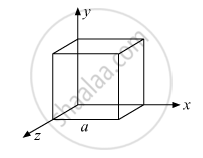
Find out the outward flux to a point charge +q placed at the centre of a cube of side ‘a’. Why is it found to be independent of the size and shape of the surface enclosing it? Explain.
Advertisements
Solution
Let a cube of side a enclose charge +q at its centre.
Because the electric flux through the square surface is `phi=q/(6in_0)`the square surfaces of cube are six. Hence, according to Gauss’s theorem in electrostatics, the total outward flux due to a charge +q of a cube is
`phi=6xx(q/(6in_0))=q/in_0`
The result shows that the electric flux passing through a closed surface is proportional to the charge enclosed. In addition, the result reinforces that the flux is independent of the shape and size of the closed surface.
APPEARS IN
RELATED QUESTIONS
Write S.I unit of electric flux.
Given the electric field in the region `vecE=2xhati`, find the net electric flux through the cube and the charge enclosed by it.
Consider a uniform electric field E = 3 × 10³ `hat i` N/C.
- What is the flux of this field through a square of 10 cm on a side whose plane is parallel to the yz plane?
- What is the flux through the same square if the normal to its plane makes a 60° angle with the x-axis?
The electric field in a region is given by `vec"E"` = 5 `hatk`N/C. Calculate the electric flux Through a square of side 10.0 cm in the following cases
- The square is along the XY plane
- The square is along XZ plane
- The normal to the square makes an angle of 45° with the Z axis.
The S.I. unit of electric flux is ______
What will be the total flux through the faces of the cube (figure) with side of length a if a charge q is placed at

- A: a corner of the cube.
- B: mid-point of an edge of the cube.
- C: centre of a face of the cube.
- D: mid-point of B and C.
The electric charges are distributed in a small volume. The flux of the electric field through a spherical surface of radius 10 cm surrounding the total charge is 20 V-m. The flux over a concentric sphere of radius 20 cm will be ______.
A hollow sphere of radius R has a point charge q at its centre. Electric flux emanating from the sphere is X. How will the electric flux change, if at all, when charge q is replaced by an electric dipole?
Electric flux through a surface is defined as which of the following?
What does positive electric flux indicate?
