Advertisements
Advertisements
प्रश्न
Given a uniform electric filed \[\vec{E} = 4 \times {10}^3 \ \hat{i} N/C\]. Find the flux of this field through a square of 5 cm on a side whose plane is parallel to the Y-Z plane. What would be the flux through the same square if the plane makes a 30° angle with the x-axis?
Advertisements
उत्तर
When the plane is parallel to the y-z plane:
\[\text { Electric flux }, \phi = \vec{E .} A^\rightharpoonup \]
\[\text { Here }: \]
\[ \vec{E} = 4 \times {10}^3 \ \hat{i} N/C\]
\[ A^\rightharpoonup = \left( 5 cm \right)^2 \ \hat{i} = 0 . 25 \times {10}^{- 2} \ \hat{i} m^2 \]
\[ \therefore \phi = \left( 4 \times {10}^3 \ \hat{i} \right) . \left( 25 \times {10}^{- 4} \ \hat{i} \right)\]
\[ \Rightarrow \phi = 10 \text { Weber }\]
When the plane makes a 30° angle with x-axis, the area vector makes a 60° angle with the x-axis.
\[\phi = \vec{E .} \vec{A} \]
\[ \Rightarrow \phi = EA \cos\theta\]
\[ \Rightarrow \phi = \left( 4 \times {10}^3 \right)\left( 25 \times {10}^{- 4} \right)\cos60°\]
\[ \Rightarrow \phi = \frac{10}{2}\]
\[ \Rightarrow \phi = 5 \text { Weber }\]
APPEARS IN
संबंधित प्रश्न
Given a uniform electric field `vecE=5xx10^3hati`N/C, find the flux of this field through a square of 10 cm on a side whose plane is parallel to the y-z plane. What would be the flux through the same square if the plane makes a 30° angle with the x-axis ?
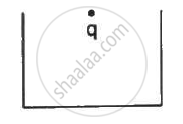
A charge q is placed at the centre of the open end of a cylindrical vessel (see the figure). The flux of the electric field through the surface of the vessel is ____________ .
A charge 'Q' µC is placed at the centre of a cube. The flux through one face and two opposite faces of the cube is respectively ______.
The SI unit of electric flux is ______.
If the electric flux entering and leaving an enclosed surface respectively is Φ1 and Φ2, the electric charge inside the surface will be
What is the dimensional formula for electric flux?
According to the rain analogy for electric flux, what determines how much rain (field) passes through a tilted sheet of cardboard?
For an open surface, which statement correctly describes the area vector convention?
For a surface inclined at an angle such that 0° < θ < 90°, which statement correctly describes the flux?
What does positive electric flux indicate?
