Advertisements
Advertisements
प्रश्न
"The outward electric flux due to charge +Q is independent of the shape and size of the surface which encloses is." Give two reasons to justify this statement.
Advertisements
उत्तर
The outward electric flux due to the charge enclosed inside a surface is the number of electric field lines coming out of the surface.
The outward electric flux due to charge +Q is independent of the shape and size of the surface, which encloses it because of the following reasons:
(i) Number of electric field lines coming out from a closed surface enclosing the charge depends on the charge enclosed by the surface, which remains constant with shape and size of the conductor.
(ii) Number of electric field lines coming out from a closed surface enclosing the charge is independent of the position of the charge inside the closed surface.
APPEARS IN
संबंधित प्रश्न
Define Electric Flux.
A small plane area is rotated in an electric field. In which orientation of the area, is the flux of the electric field through the area maximum? In which orientation is it zero?
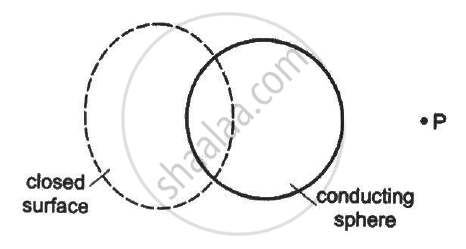
The following figure shows a closed surface that intersects a conducting sphere. If a positive charge is placed at point P, the flux of the electric field through the closed surface
Electric charges are distributed in a small volume. The flux of the electric field through a spherical surface of radius 10 cm surrounding the total charge is 25 V m. The flux over a concentric sphere of radius 20 cm will be _____________ .
A uniform electric field of intensity 400 N/C, exists in a certain region. How much flux will cross a given area of 10 cm2 in this region, if the area vector is inclined at 60° to the direction of the field?
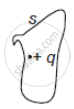
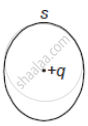
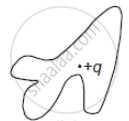
The electric flux through the surface ______.
 |
 |
 |
 |
| (i) | (ii) | (iii) | (iv) |
The electric field intensity due to an infinite cylinder of radius R and having charge q per unit length at a distance rir r(r > R) from its axis is ______.
The electric field in a region is given by `bar"E" = 4hat"i" + 10hat"j"` N/C. The flux of this field through a square of 10 cm on a side whose plane is parallel to the XZ plane.
Electric flux through a surface is defined as which of the following?
