Advertisements
Advertisements
प्रश्न
What is the electric flux through a cube of side 1 cm which encloses an electric dipole?
Advertisements
उत्तर
As per the Gauss's law of electrostatics, electric flux through a closed surface is given by
`phi_E=ointvecE.vec(ds)=Q/epsilon_0 `
where
E = Electrostatic field
Q = Total charge enclosed by the surface
∮E=∮E→.ds→=0ε0=0" role="presentation" style="position: relative;">∮E=∮E→.ds→=0ε0=0
∈0 = Absolute electric permittivity of free space
In the given case, cube encloses an electric dipole. Therefore, the total charge enclosed by the cube is zero, i.e. Q = 0.
Therefore, from (i), we have
`phi_E=ointvecE.vec(ds)=0/epsilon_0=0`
APPEARS IN
संबंधित प्रश्न
Given the electric field in the region `vecE=2xhati`, find the net electric flux through the cube and the charge enclosed by it.
Define Electric Flux.
Two charges of magnitudes −3Q and + 2Q are located at points (a, 0) and (4a, 0) respectively. What is the electric flux due to these charges through a sphere of radius ‘5a’ with its centre at the origin?
A small plane area is rotated in an electric field. In which orientation of the area, is the flux of the electric field through the area maximum? In which orientation is it zero?
A circular disc of radius 'r' is placed along the plane of paper. A uniform electric field `vec"E"` is also present in the plane of paper. What amount of electric flux is associated with it?

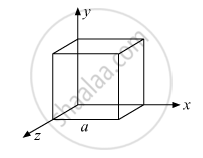
What will be the total flux through the faces of the cube (figure) with side of length a if a charge q is placed at

- A: a corner of the cube.
- B: mid-point of an edge of the cube.
- C: centre of a face of the cube.
- D: mid-point of B and C.
The electric charges are distributed in a small volume. The flux of the electric field through a spherical surface of radius 10 cm surrounding the total charge is 20 V-m. The flux over a concentric sphere of radius 20 cm will be ______.
The formula for electric flux when the electric field is uniform is expressed as which of the following?
According to the rain analogy for electric flux, what determines how much rain (field) passes through a tilted sheet of cardboard?
What does negative electric flux indicate?
