Advertisements
Advertisements
प्रश्न
Two charges of magnitudes −2Q and +Q are located at points (a, 0) and (4a, 0) respectively. What is the electric flux due to these charges through a sphere of radius ‘3a’ with its centre at the origin?
Advertisements
उत्तर
Gauss’ theorem states that the electric flux through a closed surface enclosing a charge is equal to (1/ε0) times the magnitude of the charge enclosed.
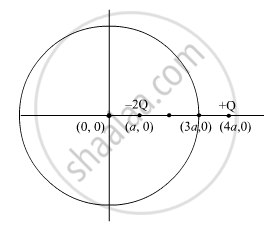
The sphere encloses a charge of -2Q thus, `phi 2Q/epsilon_0`
APPEARS IN
संबंधित प्रश्न
What is the net flux of the uniform electric field of previous question through a cube of side 20 cm oriented so that its faces are parallel to the coordinate planes?
Define Electric Flux.
A thin straight infinitely long conducting wire having charge density λ is enclosed by a cylindrical surface of radius r and length l, its axis coinciding with the length of the wire. Find the expression for the electric flux through the surface of the cylinder.
If the flux associated with a coil changes at the rate of 360 webers every 4 minutes, then the induced e.m.f. is ______
A charge Qµc is placed at the centre of a cube the flux coming from any surface will be.
A hollow sphere of radius R has a point charge q at its centre. Electric flux emanating from the sphere is X. How will the electric flux change, if at all, when charge q is replaced by an electric dipole?
When the surface normal is parallel to the electric field (θ = 0°), what is the value of the flux?
For a surface inclined at an angle such that 0° < θ < 90°, which statement correctly describes the flux?
What does positive electric flux indicate?
What is the key difference between the flux formula for an open surface and a closed surface?
