Advertisements
Advertisements
प्रश्न
Two charges of magnitudes −2Q and +Q are located at points (a, 0) and (4a, 0) respectively. What is the electric flux due to these charges through a sphere of radius ‘3a’ with its centre at the origin?
Advertisements
उत्तर
Gauss’ theorem states that the electric flux through a closed surface enclosing a charge is equal to (1/ε0) times the magnitude of the charge enclosed.
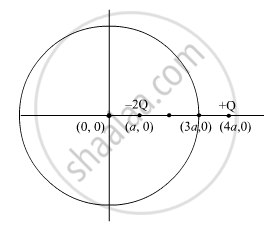
The sphere encloses a charge of -2Q thus, `phi 2Q/epsilon_0`
APPEARS IN
संबंधित प्रश्न
How does the electric flux due to a point charge enclosed by a spherical Gaussian surface get affected when its radius is increased?
Consider a uniform electric field E = 3 × 10³ `hat i` N/C.
- What is the flux of this field through a square of 10 cm on a side whose plane is parallel to the yz plane?
- What is the flux through the same square if the normal to its plane makes a 60° angle with the x-axis?
Careful measurement of the electric field at the surface of a black box indicates that the net outward flux through the surface of the box is 8.0 × 10³ N m2/C.
- What is the net charge inside the box?
- If the net outward flux through the surface of the box were zero, could you conclude that there were no charges inside the box? Why or Why not?
Define Electric Flux.
Electric charges are distributed in a small volume. The flux of the electric field through a spherical surface of radius 10 cm surrounding the total charge is 25 V m. The flux over a concentric sphere of radius 20 cm will be _____________ .
The electric flux through a closed Gaussian surface depends upon ______.
The electric field in a region is given by `vec"E"` = 5 `hatk`N/C. Calculate the electric flux Through a square of side 10.0 cm in the following cases
- The square is along the XY plane
- The square is along XZ plane
- The normal to the square makes an angle of 45° with the Z axis.
What is the SI unit of electric flux?
What is the key difference between the flux formula for an open surface and a closed surface?
