Advertisements
Advertisements
प्रश्न
A hollow cylinder has a charge of 'q' C within it. If 𝜙 is the electric flux associated with the curved surface B, the flux linked with the plane surface A will be ______.

पर्याय
\[\frac {𝜙}{3}\]
\[\frac {q}{ε_0}\] - 𝜙
\[\frac {q}{3ε_0}\]
\[\frac {1}{2}\]\[\left(\frac{q}{\varepsilon_{0}}-\phi\right)\]
Advertisements
उत्तर
A hollow cylinder has a charge of 'q' C within it. If 𝜙 is the electric flux associated with the curved surface B, the flux linked with the plane surface A will be \[\frac {1}{2}\]\[\left(\frac{q}{\varepsilon_{0}}-\phi\right)\].
Explanation:
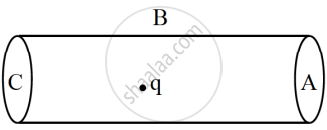
As per Gauss' law the net flux through closed surface is,
\[\phi_\mathrm{A}+\phi_\mathrm{B}+\phi_\mathrm{C}=\frac{\mathrm{q}}{\varepsilon_0}\]
Due to symmetry, the same flux passes through plane surface A and C, i.e., 𝜙A = 𝜙C
\[\therefore\] 2𝜙A + 𝜙 = \[\frac {q}{ε_0}\] ...(Given: 𝜙B = 𝜙)
\[\phi_\mathrm{A}=\frac{1}{2}\left(\frac{\mathbf{q}}{\varepsilon_0}-\phi\right)\]
