Advertisements
Advertisements
प्रश्न
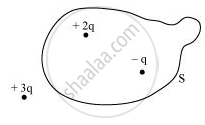
Figure shows three point charges +2q, −q and + 3q. Two charges + 2q and −q are enclosed within a surface ‘S’. What is the electric flux due to this configuration through the surface ‘S’?
Advertisements
उत्तर
The net electric flux through the surface ‘S’ is`q/epsi_0`, where `epsi_0 `is the permittivity of free space.
APPEARS IN
संबंधित प्रश्न
Consider a uniform electric field E = 3 × 10³ `hat i` N/C.
- What is the flux of this field through a square of 10 cm on a side whose plane is parallel to the yz plane?
- What is the flux through the same square if the normal to its plane makes a 60° angle with the x-axis?
Given a uniform electric filed \[\vec{E} = 4 \times {10}^3 \ \hat{i} N/C\]. Find the flux of this field through a square of 5 cm on a side whose plane is parallel to the Y-Z plane. What would be the flux through the same square if the plane makes a 30° angle with the x-axis?
Mark the correct options:
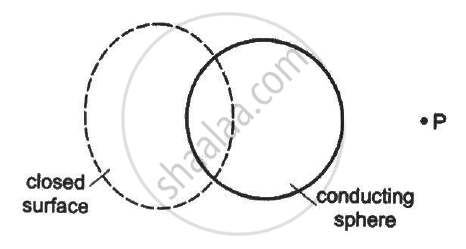
The following figure shows a closed surface that intersects a conducting sphere. If a positive charge is placed at point P, the flux of the electric field through the closed surface
If the flux associated with a coil changes at the rate of 360 webers every 4 minutes, then the induced e.m.f. is ______
In a region of space having a uniform electric field E, a hemispherical bowl of radius r is placed. The electric flux Φ through the bowl is:
A hollow sphere of radius R has a point charge q at its centre. Electric flux emanating from the sphere is X. How will the electric flux change, if at all, when radius of the sphere is doubled?
Electric flux through a surface is defined as which of the following?
The formula for electric flux when the electric field is uniform is expressed as which of the following?
Electric flux is a scalar quantity, but its value can be positive, negative, or zero. What does this depend on?
