Advertisements
Advertisements
प्रश्न
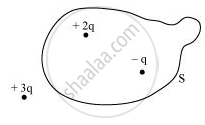
Figure shows three point charges +2q, −q and + 3q. Two charges + 2q and −q are enclosed within a surface ‘S’. What is the electric flux due to this configuration through the surface ‘S’?
Advertisements
उत्तर
The net electric flux through the surface ‘S’ is`q/epsi_0`, where `epsi_0 `is the permittivity of free space.
APPEARS IN
संबंधित प्रश्न
What is the net flux of the uniform electric field of previous question through a cube of side 20 cm oriented so that its faces are parallel to the coordinate planes?
Define Electric Flux.
Given a uniform electric filed \[\vec{E} = 4 \times {10}^3 \ \hat{i} N/C\]. Find the flux of this field through a square of 5 cm on a side whose plane is parallel to the Y-Z plane. What would be the flux through the same square if the plane makes a 30° angle with the x-axis?
Two charges of magnitudes −2Q and +Q are located at points (a, 0) and (4a, 0) respectively. What is the electric flux due to these charges through a sphere of radius ‘3a’ with its centre at the origin?
The electric flux through a closed Gaussian surface depends upon ______.
The SI unit of electric flux is ______.
Total electric flux coming out of a unit positive charge kept in air is ______.
A hollow sphere of radius R has a point charge q at its centre. Electric flux emanating from the sphere is X. How will the electric flux change, if at all, when charge q is replaced by an electric dipole?
In the electric flux formula \[\Phi = EA \cos \theta\], what does θ represent?
When the surface normal is parallel to the electric field (θ = 0°), what is the value of the flux?
