Advertisements
Advertisements
प्रश्न
Given a uniform electric field \[\vec{E} = 2 \times {10}^3 \ \hat{i}\] N/C, find the flux of this field through a square of side 20 cm, whose plane is parallel to the y−z plane. What would be the flux through the same square, if the plane makes an angle of 30° with the x−axis ?
Advertisements
उत्तर
When the plane is parallel to the y-z plane:
\[\phi = \vec{E .} A^\rightharpoonup \]
\[Here: \]
\[ \vec{E} = 2 \times {10}^3 \ \hat{i} N/C\]
\[ A^\rightharpoonup = \left( 20 cm \right)^2 \hat{i} = 4 \times {10}^{- 2} \ \hat{i} m^2 \]
\[ \therefore \phi = \left( 2 \times {10}^3 \ \hat{i} \right) . \left( 4 \times {10}^{- 2} \ \hat{i} \right)\]
\[ \Rightarrow \phi = 80 \ \text { Weber }\]
When the plane makes a 30° angle with the x-axis, the area vector makes a 60° angle with the x-axis.
\[\phi = \vec{E .} A^\rightharpoonup \]
\[ \Rightarrow \phi = EA \cos\theta\]
\[ \Rightarrow \phi = \left( 2 \times {10}^3 \right)\left( 4 \times {10}^{- 2} \right)\cos60°\]
\[ \Rightarrow \phi = \frac{80}{2}\]
\[ \Rightarrow \phi = 40 \text { Weber}\]
APPEARS IN
संबंधित प्रश्न
Two charges of magnitudes −2Q and +Q are located at points (a, 0) and (4a, 0) respectively. What is the electric flux due to these charges through a sphere of radius ‘3a’ with its centre at the origin?
Two charges of magnitudes −3Q and + 2Q are located at points (a, 0) and (4a, 0) respectively. What is the electric flux due to these charges through a sphere of radius ‘5a’ with its centre at the origin?
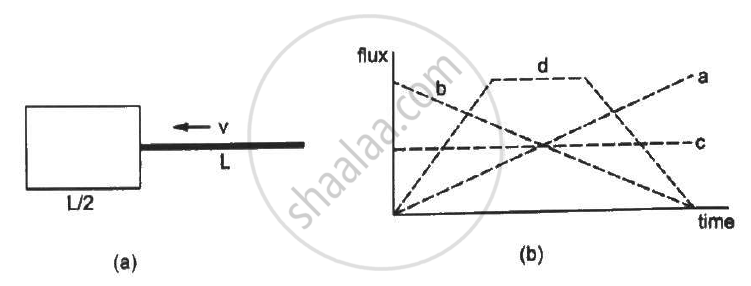
Following Figure (a) shows an imaginary cube of edge L/2. A uniformly charged rod of length (L) moves towards the left at a small but constant speed `nu.` At t = 0, the left end just touches the centre of the face of the cube opposite it. Which of the graphs shown in the figure (b) represents the flux of the electric field through the cube as the rod goes through it?
If the flux associated with a coil changes at the rate of 360 webers every 4 minutes, then the induced e.m.f. is ______
An electric charge q is placed at the centre of a cube of side a. The electric flux on one of its faces will be ______.
What will be the total flux through the faces of the cube (figure) with side of length a if a charge q is placed at

- A: a corner of the cube.
- B: mid-point of an edge of the cube.
- C: centre of a face of the cube.
- D: mid-point of B and C.
For a general surface, electric flux is calculated using which integral expression?
For an open surface, which statement correctly describes the area vector convention?
When the surface normal is parallel to the electric field (θ = 0°), what is the value of the flux?
