Advertisements
Advertisements
प्रश्न
Careful measurement of the electric field at the surface of a black box indicates that the net outward flux through the surface of the box is 8.0 × 10³ N m2/C.
- What is the net charge inside the box?
- If the net outward flux through the surface of the box were zero, could you conclude that there were no charges inside the box? Why or Why not?
Advertisements
उत्तर
(a) Φ = 8 × 10³ N m2 C−1
`q/ε_0 = 8 xx 10^3` N m2 C−1
∴ q = 8 × 10³ ε0
= 8 × 103 × 8.85 × 10−12
= 7.08 × 10⁻⁸ C
(b) As Φ = 0
`q_"net"/ε_0 = 0`
∴ `q_"net" = 0`
Even though a closed surface may have internal charges, the net charge it contains is zero.
संबंधित प्रश्न
Two charges of magnitudes +4Q and − Q are located at points (a, 0) and (− 3a, 0) respectively. What is the electric flux due to these charges through a sphere of radius ‘2a’ with its centre at the origin?
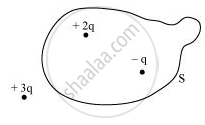
Figure shows three point charges +2q, −q and + 3q. Two charges + 2q and −q are enclosed within a surface ‘S’. What is the electric flux due to this configuration through the surface ‘S’?
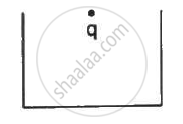
A charge q is placed at the centre of the open end of a cylindrical vessel (see the figure). The flux of the electric field through the surface of the vessel is ____________ .
A charge 'Q' µC is placed at the centre of a cube. The flux through one face and two opposite faces of the cube is respectively ______.
The SI unit of electric flux is ______.
A point charge q is placed at a distance a/2 directly above the centre of a square of side a. The electric flux through the square is ______.
A charge Qµc is placed at the centre of a cube the flux coming from any surface will be.
What will be the total flux through the faces of the cube (figure) with side of length a if a charge q is placed at

- A: a corner of the cube.
- B: mid-point of an edge of the cube.
- C: centre of a face of the cube.
- D: mid-point of B and C.
The electric charges are distributed in a small volume. The flux of the electric field through a spherical surface of radius 10 cm surrounding the total charge is 20 V-m. The flux over a concentric sphere of radius 20 cm will be ______.
A hollow cylinder has a charge of 'q' C within it. If 𝜙 is the electric flux associated with the curved surface B, the flux linked with the plane surface A will be ______.

Electric flux through a surface is defined as which of the following?
In the electric flux formula \[\Phi = EA \cos \theta\], what does θ represent?
What is the dimensional formula for electric flux?
According to the rain analogy for electric flux, what determines how much rain (field) passes through a tilted sheet of cardboard?
For a closed surface, which convention must be followed when assigning the area vector?
When the electric field direction is opposite to the area vector (θ = 180°), what is the flux?
For a surface inclined at an angle such that 0° < θ < 90°, which statement correctly describes the flux?
Electric flux is a scalar quantity, but its value can be positive, negative, or zero. What does this depend on?
