Advertisements
Advertisements
प्रश्न
A thin straight infinitely long conducting wire having charge density λ is enclosed by a cylindrical surface of radius r and length l, its axis coinciding with the length of the wire. Find the expression for the electric flux through the surface of the cylinder.
Advertisements
उत्तर

The thin infinitely long straight line has a linear charge density λ.
Since the electric field for this kind of configuration will be radial and perpendicular to the wire, there will be no flux through the flat surfaces of the cylinder. Also, the electric field (E) will be constant at every point on the curved surface of the cylinder (as all points on it are equidistant from the wire) and perpendicular to it.
We shall us Gauss's law to find the electric flux through the cylinder. The charge enclosed by the cylinder is λ × l, as l is the length of the cylinder and it is also the length of the charged wire within the cylinder.
We know,
`\text { Electric flux} = (\text { Charge enclosed})/epsi_0 = (lambdal)/epsi_0`
APPEARS IN
संबंधित प्रश्न
Define electric flux.
Write S.I unit of electric flux.
Consider a uniform electric field E = 3 × 10³ `hat i` N/C.
- What is the flux of this field through a square of 10 cm on a side whose plane is parallel to the yz plane?
- What is the flux through the same square if the normal to its plane makes a 60° angle with the x-axis?
Define Electric Flux.
Given a uniform electric field \[\vec{E} = 2 \times {10}^3 \ \hat{i}\] N/C, find the flux of this field through a square of side 20 cm, whose plane is parallel to the y−z plane. What would be the flux through the same square, if the plane makes an angle of 30° with the x−axis ?
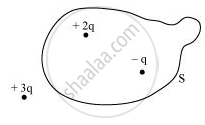
Figure shows three point charges +2q, −q and + 3q. Two charges + 2q and −q are enclosed within a surface ‘S’. What is the electric flux due to this configuration through the surface ‘S’?
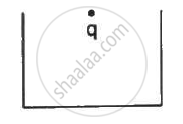
A charge q is placed at the centre of the open end of a cylindrical vessel (see the figure). The flux of the electric field through the surface of the vessel is ____________ .
The electric flux through a closed Gaussian surface depends upon ______.
An electric charge q is placed at the centre of a cube of side a. The electric flux on one of its faces will be ______.
